
Introduction:
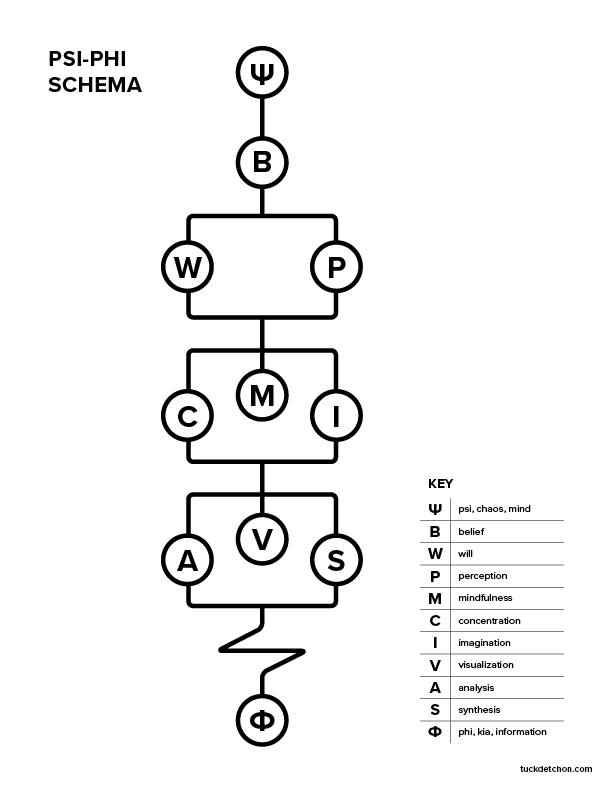
This graphic (which I’m calling the PSI-PHI SCHEMA) depicts the “basic (‘psychological’) operations” (contrasting the “classical magickal (or ‘parapsychological’) operations” which represent the forms the basic operations take at the parapsychological level).
Much of this post will consist of my justification for placing Belief so high up in the diagram, that is, closer to the root, source, or origin (“upstream”) of the rest of the psychological and parapsychological “operations”; an explanation of the concept of “deep belief”; an argument for the meta-belief not merely that belief is a tool, but that reality springs from the cosmic consensus of the beliefs of every being in reality; a characterization of interaction with and change of reality as an act of persuasion; a depiction of all belief as delusional, and belief-delusion as the basis of the self its beingness; and and a call to arms to the effect that we can and should persuade and convince the cosmos, through any and all means available to us, to help us to save and liberate the world.
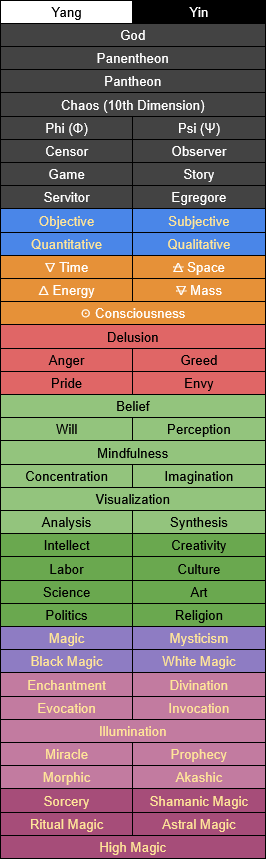
Below are two updated versions of the tables/graphics I included in the Image/Graphic Post from a couple months ago, (and I have arranged them below to maximize their phallic resemblance, as is my right):

The very first image of the three, the tree-like diagram (the PSI-PHI SCHEMA) lays out in greater detail some of the main points of The PSI-PHI Matrix (PPM) framework (which itself needs review and revision) and as a component of the PPM it therefore is for the most part inspired by borrowed from Peter J. Carroll’s seminal Chaos Magick scriptures Liber Null & Psychonaut and Liber Kaos:
Belief:
“Mainstream psychology and related disciplines have traditionally treated belief as if it were the simplest form of mental representation and therefore one of the building blocks of conscious thought.” (Wikipedia, “Belief”)
“It takes only the acceptance of a single belief to make someone a magician. It is the meta-belief that belief is a tool for achieving effects.” (Liber Kaos, pg. 77)
“Truly I tell you, if you have faith as small as a mustard seed, you can say to this mountain, ‘Move from here to there,’ and it will move. Nothing will be impossible for you.” (Matthew 17:20, NIV)
Will & Perception, Imagination & Concentration, Analysis & Synthesis:
“Duality describes humanity’s usual condition. … All phenomena must be paired, as the senses are only equipped to perceive differences. The thinking mind has the property of splitting everything it encounters into two, as it is a dualistic thing itself. Yet there is a part of man which is of a singular nature, although the mind is unable to perceive it as such. Man considers himself a center of will and a center of perception. Will and perception are not separate but only appear so to the mind. The unity which appears to the mind to exert the twin functions of will and perception is called Kia by magicians. Sometimes it is called the spirit, or soul, or life force, instead. … Kia is capable of occult power because it is a fragment of the great life force of the universe. … The ‘thing’ responsible for the origin and continued action of events is called Chaos by magicians. … Chaos … is the force which has caused life to evolve itself out of dust, and is currently most concentratedly manifest in the human life force, or Kia, where it is the source of consciousness. … To the extent that the Kia can become one with Chaos it can extend its will and perception into the universe to accomplish magic.” (Peter J. Carroll, Liber Null & Psychonaut, pgs. 27 & 28)
“The Sword and Pentacle are weapons of analysis and synthesis respectively. […] The wand is the weapon of will and the cup that of perception.” (Liber Null & Psychonaut, pg. 187)
“Thus, all magical operations are based on the use of will, perception and imagination, which is to say that they are all species of enchantment or divination. Imagination is that which occurs when will and perception stimulate each other.” (Liber Kaos, pgs. 158 & 159)
“[T]he four magical virtues [are] will, perception, imagination and concentration.” (Liber Kaos pg. 201)
Imagination, Concentration, Visualization:
“ASTRAL MAGIC … is performed by visualization and altered states of consciousness, or gnosis, alone.” (Liber Kaos, pg. 160)
“Shamanic magic depends on the use of altered states of consciousness in which active visualization and passive vision seeking can most easily occur.” (Liber Kaos, pg. 167)
“In shamanic enchantment, you seek to impress your will upon the world by a direct or symbolic visualization of your desire. … It is not unusual for the visualization to become somewhat symbolic, distorted or colored by your imagination. In general these distractions should be banished by greater concentration on the desired visualization.” (Liber Kaos, pgs. 169-170)
“In all cases [of Ritual Enchantment], the magician must use gnosis and concentration upon the spell itself, rather than the desire it represents to work effective enchantments.” (Liber Kaos, pg. 175)
“[In Ritual Invocation] You also adapt your behavior, thoughts, and visualizations while in gnosis in an attempt to become possessed by what you invoke.” (Liber Kaos, pg. 176)
“Astral magic is ritual magic performed entirely on the plane of visualization and imagination.” (Liber Kaos, pg. 177)
I have tidied it up and slightly modified the system in drafting the PSI-PHI SCHEMA tree diagram:
- Adding “Belief” prior to “Will” and “Perception” (more on this below).
- Adding “Mindfulness.” (From (the Westernization of) Eastern meditation traditions, chiefly Buddhism.)
- Adding “Visualization.” (I can’t seem to find the pages in the above two books I was certain described this operation as the product of Concentration and Imagination, but, Visualization is discussed at length in both. Did I get Mandela Effected bros.)
- The grouping, order, and arrangement of the different levels.
- Caesura (line break indicating discontinuity, in this case representing a very large number of additional (psychological) operations derived from the visible ones).
- PHI (Φ) borrowed from materialist panpsychic Integrated Information Theory (IIT), and the specific nature of the use of PSI (Ψ), borrowed and adapted from parapsychology.
Carroll uses PSI (Ψ) in the online version of his spell and counterspell equations, representing magickal factor (replacing “M” in the original version in Liber Kaos), but I use it differently, leapfrogging off of his concept of “aether” in the same book and generalizing it into the all-encompassing, Akashic/Morphic, panpsychic, cosmic field and the basis of the existence and experience of phenomena and beings in all variations of material and ideal form and formlessness. For my original attempt at outlining this framework see The PSI-PHI Matrix (PPM). (I plan on revisiting and revising this and the other main posts on this blog.) A summary is further below, but first some remaining concerns about the lineage of PSI (Ψ) and PHI (Φ). (For a more in depth look at some of the different traditional uses of both symbols, see the PPM post.)
Carroll provides his equations of magick:
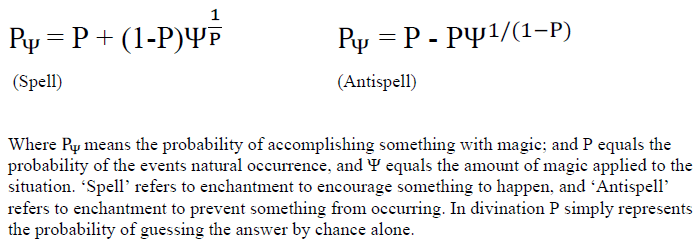
He continues:
“Unfortunately the ‘ingredients’ of Ψ [‘magickal factor’] do not equate to easily measurable phenomena: Ψ = GLSB Where G equals Gnosis, two particular altered states of consciousness, L means the magical Link, S means Subliminal-isation of intent, and B means Belief.” (Peter J. Carroll, “Chaos Magic In a Nutshell”, specularium.org; w/ changes to formatting)
As I understand and interpret these:
- Gnosis means the quality of consciousness and its intensity. I place it on a coordinate plane, with a quality axis and an intensity axis. On the X or quality axis the negative direction represents “inhibitory gnosis,” and the positive direction represents “excitatory gnosis,” and “neutral gnosis” is at the origin. I imagine the Y or intensity axis only has zero or positive values — where zero probably means you are dead (or braindead). Positive and negative X values probably tend to correspond to higher Y values, but in Condensed Chaos Phil Hine speculates about the effectiveness of “neutral” gnosis, or “sleight of mind” where desire/intent is loaded into the subconscious, and sigils/spells charged, by daydreaming and doodling and things like that.
- Magical Link means the similarity or other causal or acausal (meaningful) connection or correspondence between consciousness and something else, such as the target of a spell. Example: A photo or mentally visualized image of your enemy whom you are cursing. Seeing that person within eyeshot in real life is even better. Traditionally hair, nail clippings, blood, and so on have been used.
- Subliminalisation means the extent to which one’s mind is integrated, harmonized, and in accord with itself, particularly as it relates to the contents of ones desire/intent; the self-consciousness, pre-consciousness, and sub-conscious etc. are unified in the activity of their basic and complex psychological and parapsychological operations, and one’s desires/intents span the scope of all of these levels.
- A Belief “is a subjective attitude that something is true or a state of affairs is the case,” (Wikipedia, “Belief”). Belief can be shallow or deep within one being’s mind, but as one being is made up of many beings and is part of greater beings, and as all beings making up reality are grouped in hierarchies of size, scale, and scope, and as these Many all add up to the (N)One, deep belief can be very deep indeed…
Gnosis, Link, Subliminalisation, and Belief generate and condition “deep belief,” as the quality and intensity of our awareness of and response to our perceptions of and interactions with objects alters the contents of our consciousness at the different levels (self-conscious, pre-conscious, subconscious). Belief may be construed as a “conscious choice,” or at least subject to creation, maintenance, modification, and abandonment, sometimes in response to evidence and persuasion, but as we will see below in the discussion of the Madhyamaka school of Buddhism’s conception of the relation between belief (views) and delusion (i.e. that all views are wrong views and very deep wrong view determines our form and in which realm(s) of existence we exist, etc.), such a conscious choice doesn’t “convince” the whole “deep mind,” or modify “deep belief.” It takes mental, that is, philosophical, practical, and even mystical training and conditioning to accomplish that. This is believed to take many, many lifetimes, if we are exceedingly lucky and do all the right things. This is according to the various surviving world traditions and lineages which preserve historical soteriological knowledge, wisdom, and practice. (I don’t claim to be “enlightened,” or to have access to esoteric materials, instructions, or experiences beyond what is freely available to the public.)
The project of “awakening” or “enlightenment” is usually considered to be excessively difficult. Even basic Magick and Mysticism in general are both very difficult, rigorous, and characterized by struggle, setbacks, and trials. Non-retrogression is considered a specific, high level of attainment where the religious path is probably inevitable but still not yet secured.
I identify (rather, choose to believe because it’s tidy and makes sense to me and I like it) two primary cosmic-consciousness operations occurring at two main different levels of analysis: The Observer and The Censor at both the PSI (Ψ) and PHI (Φ) levels. I call this “Punnett Square” inspired construct the PSI-PHI Matrix (PPM):
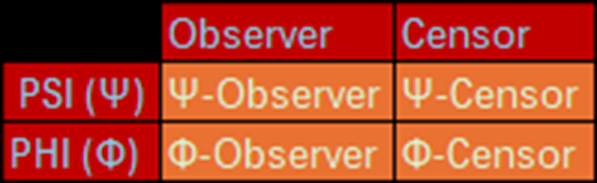
Basically, my argument is that the parapsychological domain of reality represented by PSI (Ψ) encompasses and surpasses the psychological domain represented by PHI (Φ), and is its basis: PSI (Ψ) is the content/potential and PHI (Φ) is the form/structure. PSI (Ψ) is a property of 10-dimensional Chaos…
(10-dimensional Chaos is more or less “the Omniverse.” The Omniverse is identical with the being the “Omniurge,” (Omniverse = Omniurge), just like the being the Demiurge is identical with the structure/system, the Universe (Demiurge = Universe). The being (-urge) and the body (-verse) are two ways of looking at the same thing, being and body, body and being. The Omniurge/Omniverse (being/body) is further identified with the Pantheon (“ecosystem”): the population of all entities, beings, and persons who make up and constitute the Omniverse/Omniurge. So Pantheon = Omniverse = Omniurge. This is the topmost level of the cosmic panpsychic multimind. There is a sub-Pantheon for different levels of the organization of the Omniverse, for example at the Universe/Demiurge level — but we might also say there is a local pantheon of spirits in our bodies or brains. This relates to my take on the definitions of thoughtforms, agents, and code-bodies near the bottom of the B.U.T.T.S. DLC. Furthermore, God (or your Ultimate/Absolute of choice) encompasses and surpasses Chaos and the Pantheon: God = Panentheon = God + Pantheon. See the section, “Being Delusion”, below.)
…PSI (Ψ) “loops around” on PHI (Φ) (the larger and more complex 10-dimensional point “loops around” on/into every 0-dimensional point, putting “the whole in each part”). (This is contradictory, counterintuitive, and incredibly stupid, but it works for me so lay off okay.) PSI (Ψ) is traditionally held to be the “unknown factor” or “hidden variable” (to misuse a STEM term) behind the extension of what we’re calling PHI (Φ) into the subconscious and into the larger Cosmos. Personally, I flip this around: Consciousness comes down (or rather, from within and surrounding each smallest particle, space, and moment in the all inclusive cosmic field) from PSI (Ψ), and PSI (Ψ) is the basis of PHI (Φ), not the other way around.
This is how PHI (Φ), relatively limited and finite, inherits the properties and powers of PSI (Ψ): the parapsychological ground of being is the basis of the psychological being.
PHI (Φ) is a variable representing a hypothetical objective and quantitative measure of subjective qualitative experience, the “informational integration” of a system or process which corresponds to the “level” of consciousness (“informational integration” being from materialist panpsychism’s “Integrated Information Theory (IIT)”) — in other words, its “beingness.”
In the OpenCult/MMG/10THDIM-DIAMAT-CMT/PPM paradigm (MMG = Mythic Meta-Gamification), the line of reasoning is as follows:
- In my attempted syncretic synthesis-in-progress of Rob Bryanton’s Imagining the Tenth Dimension (10THDIM) model, crossed with Peter J. Carroll’s Chaos Magic Theory (CMT), as well as the Dialectical Materialism (DIAMAT) of Hegel, Marx, Engels, Lenin, and others (I am trying to mash up these three elements into the “10THDIM-DIAMAT-CMT” “kernel” of OpenCult/MMG), all of space, time, alternate timelines, the universe, and all universes in the multiverse, are treated as a single hyperdimensional point of indeterminate size.
- As mentioned above, this 10D point “loops around” on/into every single 0D+ point in the lower dimensions: the entire cosmic whole is within each and every infinitesimal part.
- Chaos, a materialist, panpsychic cosmic mind “behind” and animating all cosmic phenomena in the omniverse, “passes down” its property of “Observation” (omnipresent, omniscient, omnipotent “interaction” or “the Self-Cognition of God”).
- The PSI-Observer, the infinite omniscient cosmic potential, is “restrained” or “quantized” by the PSI-Censor. This produces the PHI-Observer, or being dependent on some system or structure (which may be formed or formless).
- As PHI (Φ) increases, that is, as matter is informationally or computationally integrated in specific and more subtle and complex ways and at different scales, more PSI (Ψ) is “liberated,” “unlocked,” or “liberated.”
- Whereas the PSI-Censor refers to all limitation, ignorance, and amnesia applied to the omniscient PSI-Observer, PHI-Censorship refers to ignorance and amnesia resulting from the absence, degeneration, or corruption of structural, informational, or computational systems representing and referring to the truth and the obtaining state of affairs describing matter, for example neural correlates corresponding to a math equation, in the human brain, which explains the fluid dynamics of the air in a red balloon.
The Observer is basically the quantum observer from the interpretation of quantum mechanics described by the postulate “consciousness causes collapse,” but with the caveat that every possible physical interaction of particles or systems etc. is an act of cosmic, conscious observation, plus that with multimind materialist panpsychism (a kind of neo-animism) being true or obtaining, any possible instantaneous “set” of cosmic data or system is a being (including null, random, and universal sets, as well as more traditional or intuitive “beings” such as systems next to, touching, interacting, or structurally/procedurally integrated with each other as identified by the discriminating mind of a given being). I feel like this rehabilitates the discredited view that a conscious observer is necessary for the quantum observer interpretation of quantum mechanics (though as a disclaimer I’m not a scientist nor do I know almost anything about quantum physics or physics in general). This also explains how all beings have a “vote” in “manifesting their reality”, and since there are infinite beings, all these aggregate votes result in the physical form, content, and ideal and material motion in, as, and of the Omniverse.
(Importantly, this aggregate “voting” by all the numberless beings of the Panentheon operates on the level of (very deep) belief.)
The Censor is basically the psychic censor of psychoanalysis and the psychological strains of Chaos Magick, but writ cosmic, responsible for all inhibitions and limitations (e.g. ignorance and amnesia) of omniscient observation, awareness, experience, or consciousness etc. (especially of trauma, psychedelia, and miracles).
Observation (PSI-Observer) is inherited from Chaos and “implanted” into Kia by the Censor (PSI-Censor):
“Sometimes [Kia] is called the spirit, or soul, or life force … . … Kia is capable of occult power because it is a fragment of [Chaos]” (Peter J. Carroll, Liber Null & Psychonaut, qtd. by Wikipedia, “Kia”)
The PSI-PHI SCHEMA diagram shows how the basic … complex (mental) operations are enumerated and “quantized” from the whole cloth of omniscience into the primitive or primordial consciousness which is the “intrinsic nature” of all physical matter.
PSI (Ψ) being thus “censored”, PHI (Φ), or the value of measurement representing the computational, structural, or informational integration of physical systems (IIT) “liberates” the PSI (Ψ) intrinsic to the matter integrated thereby. This limited, liberated consciousness represents the mental (and physical!) activity of the PHI-Observer. All ignorance, amnesia, etc. especially of mystical/magickal results such as synchronicities, deja vu, visions, revelations, psychedelic experiences, peak experiences, dreams, etc., but in general all non-omniscience, can be interpreted as the lack of appropriate or relevant (representational or experiential) structural informational integration in the system concerned — for example the absence of the neural correlates, in a human brain, for a math equation, describing the fluid dynamics of the gas in a red balloon. This “local” ignorance and amnesia is the work of the PHI-Censor.
So, with reference to other posts on this blog, the PSI-PHI SCHEMA points to the PSI-PHI Matrix including and elaborating on the relationships among Chaos, Kia, the Basic (Psychological) Operations, the Classical Magickal (Parapsychological) Operations, the PSI-Observer, the PSI-Censor, the PHI-Observer, and the PHI-Censor.
A KABBALAH/10THDIM Reference:

After a certain point in drafting the design I noticed the obvious similarity between my diagram and Rob Bryanton’s Imagining the Tenth Dimension project logo, as well as the Sefirot “Tree of Life” of Jewish Kabbalah:
“What I find particularly interesting is that there are schools of thought within the Kabbalah which teach that we can divide our reality into three triads, which can be summed up as the material, the moral, and the intellectual. In the last chapter of my book, I reached a similar conclusion that there are three systems interacting through constructive interference, all of which in their unobserved state can be assembled into the tenth dimension as a “point” of indeterminate size. Those three systems are 1) the physical world, 2) the quantum observer who through constructive interference is actively engaged in observing specific aspects of the other two systems, and 3) the ‘information equals reality’ world … .” (Rob Bryanton, “Wrapping It Up in the Tenth Dimension”, blogspot.com)
The 10THDIM triad also can be interpreted as referring to the Buddhist cosmological triad of the Ten Directions (Space), the Ten Times (Time), and the Ten Realms (Multiverse), grouped into a single 10-dimensional point of indeterminate size we’re calling the Omniverse (and identical with Chaos, source of PSI (Ψ), Kia, and PHI (Φ) (see previous section, “Introduction”)).
Belief, Gnosis, Praxis:
“God is beyond the intellectual grasp of humans, and religious statements about the nature of God can never be taken literally. This broad conception brings together religious faith and secular and scientific concerns regarding the origin of Man and the Universe.” (Ted Farris, “A man beyond categories”, aeon.co)
“Natural science leaves no room for doubt that its assertion that the earth existed prior to man is a truth. This is entirely compatible with the materialist theory of knowledge: the existence of the thing reflected independent of the reflector (the independence of the external world from the mind) is the fundamental tenet of materialism. … From the standpoint of modern materialism, i.e., Marxism, the limits of approximation of our knowledge to objective, absolute truth are historically conditional, but the existence of such truth is unconditional, and the fact that we are approaching nearer to it is also unconditional. The contours of the picture are historically conditional, but the fact that this picture depicts an objectively existing model is unconditional. When and under what circumstances we reached … the discovery of electrons in the atom is historically conditional; but that every such discovery is an advance of ‘absolutely objective knowledge’ is unconditional. In a word, every ideology is historically conditional, but it is unconditionally true that to every scientific ideology (as distinct, for instance, from religious ideology) there corresponds an objective truth, absolute nature. … And it is this sole categorical, this sole unconditional recognition of nature’s existence outside the mind and perception of man that distinguishes dialectical materialism from relativist agnosticism and idealism.” (V.I. Lenin, Collected Works Vol. 14)
“In the theory of knowledge, as in every other branch of science, we must think dialectically, that is, we must not regard our knowledge as ready-made and unalterable, but must determine how knowledge emerges from ignorance, how incomplete, inexact knowledge becomes more complete and more exact.” (V.I. Lenin, Materialism and Empirio-criticism)
“You can only learn from experience, so be curious.” (Homeboy Sandman, “Curious”)
Guided by Chaos Magick and Dialectical vibes, I embrace eclecticism, syncretism, pluralism, and especially contradiction and even paradox. Now…
We make every kind of assumption about reality beyond the self-same experience of the content(s) of experience itself. As Philip Goff puts it in Galileo’s Error: Foundations for a New Science of Consciousness, conscious experience “is its own datum.” Despite what Lenin argues about “absolutely objective knowledge” above, in reality we assume everything about the nature and function of reality, including that there is an ultimate reality, because of the nature of our existence and experience as material beings in space and time, that is, an infinitesimally small instant constantly in motion, which ends as soon as it starts, is passed as soon as we think we have grasped it. We necessarily have faith in most things we take for granted. For example, what if we’re a brain in a vat? What if the assertion that the Earth existed prior to humanity is false?
From Wikipedia, “Münchhausen trilemma”:
“In epistemology, the Münchhausen trilemma is a thought experiment intended to demonstrate the theoretical impossibility of proving any truth, even in the fields of logic and mathematics, without appealing to accepted assumptions. If it is asked how any given proposition is known to be true, proof in support of that proposition may be provided. Yet that same question can be asked of that supporting proof and any subsequent supporting proof. The Münchhausen trilemma is that there are only three ways of completing a proof:
- “The circular argument, in which the proof of some proposition presupposes the truth of that very proposition
- “The regressive argument, in which each proof requires a further proof, ad infinitum
- “The dogmatic argument, which rests on accepted precepts which are merely asserted rather than defended”
(Yet again, “conscious experience is its own datum.” Goff also explains physics descriptions only give us properties about what things “do,” not what they “are,” and that all properties are defined, ultimately circularly, in relation to each other.)
On the other hand, we can’t live normal lives in a way that is consistent with the position of “epistemological skepticism,” which is the stance that certainty about knowledge of anything is impossible, yet, on the other other hand, even if we are forced to believe things, we can’t accept every assumption we inherit or invent at face value, or permanently. We should be critical of our own knowledge, permanently wrestling and struggling with our own mental picture of ourselves and reality, to deconstruct, reconstruct, and refine it. This may start with analyzing “knowledge” itself and defining it as a type of “belief”:
“A belief is a subjective attitude that something is true or a state of affairs is the case. A subjective attitude is a mental state of having some stance, take, or opinion about something. … In epistemology, philosophers use the term ‘belief’ to refer to attitudes about the world which can be either true or false. … Research has indicated that emotion and cognition act in conjunction to produce beliefs, and more specifically emotion plays a vital role in the formation and maintenance of beliefs.” (Wikipedia, “Belief”, en.wikipedia.org)
Emotion is related to gnosis — so this indicates or reiterates my earlier point that, akin to the basic psychological operations being applicable to each other, the components of magickal factor in Carroll’s equations of magick may also be applied to each other, or magickal factor as a whole may be applied to one or more components of magickal factor: (“Ψ = GLSB Where G equals Gnosis, two particular altered states of consciousness, L means the magical Link, S means Subliminal-isation of intent, and B means Belief.” (Peter J. Carroll, “Chaos Magic In a Nutshell”, specularium.org; w/ changes to formatting))
Knowledge is usually defined by philosophers as “justified true belief.” “Justified” means we have a good reason to believe it, regardless of its truth or falsehood. We can believe something, which is true, but our reasons could be unjustified — we didn’t study nature or our experiences, we used faulty reasoning to arrive at the right conclusion (like solving a math equation on fluid dynamics wrong and arriving at the correct result accidentally), or we believed statements intended as lies (whose speaker themself didn’t believe) which just so happened to be true.
For Marxists, practice, production, and struggle are the justifications and sources of knowledge. We can apply the other basic/psychological operations (e.g. will and perception etc.) to belief itself. We should increase the amount of mental and practical energy we apply to our own beliefs, above our default or usual “resting state,” because humans struggle with and produce our own ideas as products of personal (internal) and social (external) labor and struggle. At the risk of being too general and airy:
“Work is Labor: Metabolic, intellectual, and creative physical work i.e. the intentional/willful movement and transformation of matter (mass, energy, space, time, consciousness), especially as defined in physics as, “energy transfer that occurs when an object is moved over a distance by an external force …” (Encyclopædia Britannica). We can conceive of every application of embodied will and perception as Labor/Work, as even thinking and feeling transfer energy and move mass within the brain (albeit at small scales). Biology, chemistry, physics etc. are also like this. Furthermore, intellect and creativity are present in all applications of will and perception. All Labor, or “Work,” is intellectual and creative.” (Mythic Meta-Gamification (MMG))
… And belief is work, too.
To bring things back down to Earth:
“Where do correct ideas come from? Do they drop from the skies? No. Are they innate in the mind? No. They come from social practice, and from it alone; they come from three kinds of social practice, the struggle for production, the class struggle and scientific experiment.” (Mao Zedong, “Draft Decision of the Central Committee of the Chinese Communist Party on Certain Problems in Our Present Rural Work”, marxists.org)
I like the following two terms, the āyatanas and the pramanas, as outlining a different take, from the Indian philosophy tradition, on the main justifications for beliefs as knowledge:
“In Buddhism, āyatana … is a ‘center of experience’ or ‘mental home,’ which create[s] one’s experience. The term saḷāyatana … refers to six cognitive functions, namely sight, hearing, smelling, tasting, body-cognition, and mind-cognition. … The saḷāyatana are traditionally understood as referring to the five senses and the mind.” (Wikipedia, “Āyatana”, en.wikipedia.org)
“While the number of pramanas varies widely from system to system, many ancient and medieval Indian texts identify six pramanas as correct means of accurate knowledge and attaining to the truth. Three of these are almost universally accepted: [1] perception (pratyakṣa), [2] inference (anumāna), and [3] ‘word’ (śabda), meaning the testimony of past or present reliable experts. The other three pramanas are more contentious: [4] comparison and analogy (upamāna); [5] postulation or derivation from circumstances (arthāpatti); and [6] non-perception, or proof from absence (anupalabdhi). …” (Wikipedia, “Pramana”, en.wikipedia.org)
And it may be accurate to say that belief (and even knowledge!) is not a simple on/off switch:
“… Each of these [six pramanas] are further categorized in terms of conditionality, completeness, confidence, and possibility of error.” (Wikipedia, “Pramana”, en.wikipedia.org)
“Some [philosophers] … aim to replace our bivalent notion of belief (‘either we have a belief or we don’t have a belief’) with the more permissive, probabilistic notion of credence (‘there is an entire spectrum of degrees of belief, not a simple dichotomy between belief and non-belief’).” (Wikipedia, “Belief”, en.wikipedia.org)
“[As] an example … : in Aristotelian logic, we must classify a Coca Cola can as either present in the refrigerator or not present in the refrigerator. In Koryzbskian n-valued logic, we can estimate the probability that the coke remains in the refrigerator, from 0 percent, through ten percent … up to 100 percent, depending on how much we know. In Zadeh’s fuzzy logic, we can estimate how much Coca Cola remains present in the can, e.g., full can, three-quarter full, half can … etc.” (Robert Anton Wilson, Cosmic Trigger III: My Life After Death)
In B.U.T.T.S. DLC, we looked at different code-body agents in the “Beme-ing Up Thoughtform Type Schema (B.U.T.T.S.).” Near the bottom (heh), we saw a generic definition of thoughtforms as relatively more or less formed or formless bodies defined by, made of, containing, reproducing, receiving, transmitting, encoding, decoding, and creating information, and exhibiting some kind of agency and beingness. Broadly speaking, the two main types are servitors and egregores: a servitor is usually a small fragment of one’s own mind, and an egregore is a larger mental, informational, or energetic system that one taps into.
“Fat trembled.
“’Yes,’ Dr. Stone said. ‘The Logos would be living information, capable of replicating.’
“’Replicating not through information,’ Fat said, ‘in information, but as information.’”
(Philip K. Dick, V.A.L.I.S. qtd. in Edward Wilson & Wes Unruh, The Art of Memetics)
“Every action is performed by a body, or rather; bodies are entities which perform actions.” (Wes Unruh & Edward Wilson, The Art of Memetics)
“Magick is merely to be and to do.” (Aleister Crowley, Magick, Liber ABA, Book 4)
A sigil is a symbol representing some psychological or parapsychological operation. Servitors and egregores can be imagined and represented as sigils to which they are often linked, practically speaking. The sigil can be conceived as the physical “form” their body takes. Every letter, number, operator, or character on this page can be thought of as a sigil representing a thoughtform that connects the local servitor on the page with your mind, where the servitor existing across the page and in your mind connects with complex, dynamic egregores or information systems to generate experience, the contents of consciousness, and meaning. (These systems include the brain; documents; computers; the relations among many different beings each with their own brains, documents, and computers; and the mystical, hyperdimensional “aether.”)
Language deeply conditions the mind. Remember that the main definition of belief is “a subjective attitude that something is true or a state of affairs is the case,” (Wikipedia, “Belief”). Only a logical “proposition” may be true or false. In some religious/spiritual traditions permanently silencing discursive thought is identified as a mark of enlightenment. Enlightenment is identified as a correct and true understanding of reality. Therefore, all views are wrong and no-view or non-view is the only correct and true understanding of reality. So linguistic mentation hews closely to belief in general and deep belief specifically.
But there may be a kind of language deeper than vocal/written language, “mentalese”:
“There are different ways of conceiving how mental representations are realized in the mind. One form of this is the language of thought hypothesis, which claims that mental representations have a language-like structure, sometimes referred to as ‘mentalese’. Just like regular language, this involves simple elements that are combined in various ways according to syntactic rules to form more complex elements that act as bearers of meaning.” (Wikipedia, “Belief”, en.wikipedia.org)
Normal language and mentalese roughly correspond with the memes and bemes of the B.U.T.T.S. DLC. Mentalese (bemes) and normal language (memes) interact with each other. In B.U.T.T.S., bemes and memes convert into each other, going up and down the scales of the schema.
But information describes things, and code, a kind of information, tells things what to do and how. Agents/bodies do actions:
“Functionalism … defines beliefs … in terms of the function or the causal role played by them. This view is often combined with the idea that the same belief can be realized in various ways and that it does not matter how it is realized as long as it plays the causal role characteristic to it … whatever is caused by perceptions in a certain way and also causes behavior in a certain way is called a belief. This is not just true for humans but may include animals, hypothetical aliens or even computers.” (Wikipedia, “Belief”, en.wikipedia.org)
If we natively define beliefs as a category/content of consciousness, and associate beliefs with conscious beings and beingness, then the functionalist view of belief blurs the lines distinguishing between beings and non-beings even further than we already have done throughout the posts on this blog. It’s beings all the way down. And as we can analyse or decompose systems/networks (“thoughtforms”) into servitors, we can also synthesize or combine them into egregores:
“[I]ndividuals who together collectively believe something need not personally believe it individually. … Collective belief can play a role in social control and serve as a touchstone for identifying and purging heresies, deviancy or political deviationism.” (Wikipedia, “Belief”, en.wikipedia.org)
“Most disorganized of all religions, Discordianism alone understands that organization is the work of the Devil. … If the Discordian Society is to become the world’s next great cargo cult it will be due to the efforts of the House of Mirrors. Not only have we nunneries, but recognized and accepted heresies … . … POEE proclaims … that creative disorder, like creative order, is possible and desirable; and that destructive order, like destructive disorder, is unnecessary and undesirable.” (Malaclypse the Younger (Gregory Hill) & Ravenhurst (Kerry Thornley), Principia Discordia)

An additional, further heresy is that revolutionary destruction of the old order is necessary to rebuild the world according to humanity’s true collective and cooperative nature, and for history to evolve from the lower stage of capitalism imperialism to the higher stage of communism. World Revolutionary War will be necessary to save the World from Fascism and Omnicide and liberate it from Capitalism-Imperialism, Colonialism, Cis-hetero-patriarchy, Ableism, Theocracy, and other dimensions of intersectional, systemic, and structural class/identity exploitation, oppression, abuse, and violence.
“Modern bourgeois society, with its relations of production, of exchange and of property, a society that has conjured up such gigantic means of production and of exchange, is like the sorcerer who is no longer able to control the powers of the nether world whom he has called up by his spells.” (Karl Marx & Frederick Engels, Manifesto of the Communist Party)
“Capital is dead labour, that, vampire-like, only lives by sucking living labour, and lives the more, the more labour it sucks”. (Karl Marx, Capital Volume One, marxists.org)
“A spectre is haunting Europe — the spectre of communism.” (Karl Marx & Frederick Engels, Manifesto of the Communist Party)
As they say, “Study, Study, Study; Educate, Agitate, Organize.”
“Because goals are based … in part on beliefs, the success or failure at a particular goal may contribute to modification of beliefs that supported the original goal.” (Wikipedia, “Belief”, en.wikipedia.org)
“Praxis is the process by which a theory, lesson, or skill is enacted, embodied, realized, applied, or put into practice. ‘Praxis’ may also refer to the act of engaging, applying, exercising, realizing, or practising ideas.” (Wikipedia, “Praxis”, en.wikipedia.org)
To recapitulate and expand on the above, we are compelled by the circumstances of our existence and experience to make assumptions, beliefs held at various levels and degrees of faith — but almost everything fundamentally relies on faith. Our beliefs arise from our dynamic internal and external contradictions, particularly physical struggle with ourselves, society, and nature, in the domains of labor, the intellect, and creativity. This struggle justifies our beliefs, and if they are justified true beliefs, or they obtain as a state of affairs, then they are knowledge. Knowledge is relative, approximate, and provisional, tending through struggle and science towards increasingly perfect and absolute knowledge. Belief is fundamental, and is shaped by reality, from the materialist perspective — but it may also shape reality, from the religious/spiritual perspective (the inverse, that materialism accounts for consciousness as a material condition, and religion accounts and responds to society and nature, is also a vital part of the picture).
This blog seeks to synthesize an anarchistic anti-theocracy (theo-anarchy?) out of political communism and religious occultism. Aleister Crowly’s motto was “The method of science, the aim of religion,” but we might make the following three steps:
- The method of science, the aim of religion.
- The method of religion, the aim of politics.
- The method of magick, the aim of communism.
Originally Chaos Magick is postmodern in its rejection of absolute truth, or even stable personal belief. I think we might negate the negation and accept that there is a potential absolute truth perfectly describing the ultimate reality, but this perfect description of the ultimate reality is identical with the ultimate reality — thus, knowledge is relative, approximate, and provisional, and tends towards the limit of perfect, absolute, and ultimate knowledge.
I think it bears mentioning (hey, this is my show) that in my view only God has the capability of true knowledge, because true knowledge is totalizing and complete. There is only one God who knows they are God and is correct, and there are probably infinite gods and other beings possessed of the delusion that they are God (they are not … probably?).
If, in a sense, any mental or conceptual representation or reference to a real existing thing is an abstraction, and abstraction is “a fragment” of a thing; and, if any contact and interaction among two systems unifies them as a single system; and, if there can be only one “all-that-exists”, there can’t be two; then we are all part of God. I imagine this line of reasoning is well established even if it is controversial.
What may be less established and even more controversial, offending the sensibilities of both sides of the theism-atheism debate, is that God is beyond existence and nonexistence, God and Their creation are contradictory and paradoxical, impossible — and so I absolutely believe in God precisely to the extent that God is impossible and does not exist. And, we and our universe are the same way.
Religious doctrine is infamously dogmatic and static once established. Chaos Magick, itself an “invented religion,” or “new religious movement (NRM)”, adopts the motto “Nothing has Ultimate Truth. Anything Remains Possible,” (Peter J. Carroll, “Chaos Magic in a Nutshell”, specularium.org). So on one hand we have eternal, static, theology; and on the other, chaotic, dynamic, temporary, arbitrary belief. With this blog, OpenCult, and Mythic Meta-Gamification (MMG), the goal is to navigate and operate within a “middle way” between stability and instability, where we construct a durable and semi-permanent religious system and worldview, yet we self-criticize and self-editorialize our belief structures to optimize them for our goals on a personalized DIY basis — in this case, Occultism and Communism.
Bullets and Associations:
The following is an outline/bullet list of terms and concepts and some short sentences. It is meant to be evocative and associative, and not exhaustive, drawing on the connections among the terms and belief, knowledge, and truth. If I were to write it out in sentence and paragraph form it would be very dense and meticulous, as well as very lengthy. I am not certain of my ability to accomplish that well, nor the reader’s desire to read something written that way:
- (Ideal) ←→ Theory ←→ Gnosis ←→ Praxis ←→ Practice ←→ (Material).
- Subject (believer) and object of belief (proposition).
- Mind, brain state, mental state, intentionality.
- “Mental sentence”.
- Pistis (trust/confidence), doxa (opinion, acceptance), and dogma (formal position)
- Occurrent (actively thinking a belief), dispositional (certain response to a question about a belief) (philosophy).
- Core (see occurrent above), dispositional (psychology).
- Emotion and cognition: Feelings, perceptions, thoughts, views, memory.
- (Belief) → Perceptions → (Belief) → Behavior → (Belief).
- Knowledge, concept, implication, suggestion, inference.
- Models, schemata, assertions, claims, hypotheses, theories, laws, rules, axioms.
- Validity:
- Motivation (Goal, purpose, intent, desire, will), Justification, Truth (Impossible, Problematic, Potential, Possible, Probable, Proven), Correctness, Credibility, Data, Information, Experience, Contemplation, Proof, Evidence, Argument, Logic, Reason, Predictive Power, Pragmatism/Utility.
- Opinions, delusions, credulity, gullibility.
- Doubt, scepticism, ignorance.
- Lies, falsehoods, deceit, corruption, counterfeit.
- Anticipation, expectation, speculation, hopes, fears.
- Ideology, False social reality, Consensus reality.
- Gnosis, mystery, wonder, faith, superstitions, revelation, inspiration.
- Agreement, disagreement, exclusion, inclusion, orthodox, heterodox, different, same.
- Pluralism, eclecticism, syncretism.
- Heresy, apostasy, schism,deviancy, and political deviationism.
- Conversion, proselytization, evangelizing, convincing, persuasion, educating, consciousness raising, re-educating, brain washing.
- Belief Systems:
- Religious.
- Philosophical.
- Political.
- Ideological.
- Combinations of these.
- Belief Specialists:
- Inquisitors.
- Missionaries.
- Agitprop groups.
- Thought-police.
- Strategic approaches (Wikipedia, “Belief”)
- Rules: “Explicit [enforced] regulative processes such as policies, laws, inspection routines, or incentives.”
- Norms: Unenforced “Regulative mechanisms accepted by the social collective.”
- Beliefs: “The collective perception of fundamental truths governing behavior.”
Being Delusion:
“Tell me lies, tell me sweet little lies
“Tell me lies
“Tell me, tell me lies
“Oh no-no, you can’t disguise
“You can’t disguise
“No, you can’t disguise
“Tell me lies, tell me sweet little lies”
(Fleetwood Mack, “Little Lies”)
“I want to believe.” (Chris Carter, The X-Files)
Repeating and expanding on some of the above:
Every possible instantaneous set of cosmological information in the Omniverse is “a Being.” This includes null, random, and universal set(s). This means infinite hierarchies of numberless beings, who make up or constitute the Omniverse. All of these beings together are the Pantheon. Each Being’s Belief “manifests” the lawful habits and emergent behaviors and properties of Nature. This means “Consensus Reality” includes the consensus and consent of numberless beings and kinds of beings.
“God” is a referent for the ineffable, unnameable, and indescribable One, Who is absolutely immanent and transcendent and Who encompasses and surpasses Reality and the Omniverse. (This is a description of “panentheism.” “Pantheism” is the view that God is equivalent to Nature.) The Panentheon, then, is an expansion of God where God = Panentheon = God + Pantheon.
Mashing up Latin prefixes with the Greek suffix yields:
- Spatiurge = Space.
- Tempurge = Time.
- Demiurge = Universe.
- Omniurge = Omniverse.
… The “consensus” of all these beings “manifesting their reality” is based on their harmonized “observation” across the PSI (Ψ) and PHI (Φ) levels — in other words, this implies that there is not just a hierarchy of depth of belief ” in, say, the human brain, where we might change our disposition towards a proposition describing the helium in a red balloon or the amount of coke in a can in the refrigerator; but where we may alter how we experience reality; where we may attain mystical Salvation, Liberation, and Enlightenment; but, finally, there is the deepest level of belief (somewhere before the impossible True Belief of God apprehending Themself and Reality), where we may change the nature or state of the ultimate or materialist cosmos itself. We may do this through conventional mundane means such as the motion of our bodies, through modifying probabilities of events occurring or not occurring, or through hypothetical and rumored miraculous powers. These latter two involve modifying our personal belief or social belief in such a fashion as to pass through deep belief, and deeper belief, into deepest belief.
We may conceive of PSI (Ψ) as the “ground of being” (“potential”) and PHI (Φ) as the “beingness” of beings (“structure”). PHI (Φ)“reaches up to” or “liberates” PSI (Ψ), modifying the relatively local or global “consensus” of relatively deep or shallow belief, knowledge, and truth. Various recursive and hierarchical patterns of consensus thus define an agent/body, its Kia, its beingness, and its form, identity, and selfhood. The flow of consciousness and information up and down the entire “vertically integrated pipeline” through the PSI-PHI SCHEMA tree, and its bandwidth and accumulation at nodes, determines the character and scope of beingness/consciousness.
Given that each para/psychological operation and component of magickal factor may be applied to each other, and given that PSI (Ψ) “loops around” on PHI (Φ) to where the PSI-PHI-MATRIX is recursively inside and surrounding itself, we can further imagine that the entire PSI-PHI SCHEMA tree is represented in some intrinsic fashion within each operation, factor, and any other element in Reality or the Omniverse.
Chaos is a “fragment” of God’s Self Belief. God’s Self is True and only God can know this with any Justification, Certainty, and Absolute Validity. This Self Knowledge requires True, Unlimited Omniscience. God casts Pantheon-Chaos as a magic spell which feeds back on itself hyperdimensionally and cascades through all levels of Cosmic hierarchy. Each smallest particle of matter has to be produced and reproduced everywhere in space, time, and multiverse in the Omniverse. In order for change and time to occur, the entire universe has to be remade completely and arranged in continuous branching timelines in eternal hypertime, and each possible universe with every possible moment of every possible timeline is similarly represented in the multiverse.
Chaos is “quantized” into Kia: Superlative subjectivity (Ψ-Observer, Ground, potential (Eternal Infinite & Void) is restricted and therefore structured (Ψ-Censor, temporalized). The “basic operations” (“B, W, P, M, C, I, V, A, S, …”) enumerate the powers and properties of the thus “limited,” localized, and individuated Kia, outputting the structurally integrated informational experience (Φ-Observer, Being) whose aggregate-form is identical with their delusion (Belief) of self. Omniscience is transformed into the property of panpsychism.
(Yin Aether, Yang Aether, Karma, and Wu Wei form the cosmic metabolism of the Omniurge.)
“The unity which appears to the mind to exert” the function of belief as well as “the twin functions of will and perception is called Kia by magicians. Sometimes it is called the spirit, or soul, or life force, instead. … Kia is capable of occult power because it is a fragment of the great life force of the universe. … The ‘thing’ responsible for the origin and continued action of events is called Chaos by magicians. … Chaos … is the force which has caused life to evolve itself out of dust, and is currently most concentratedly manifest in the human life force, or Kia, where it is the source of consciousness. … To the extent that the Kia can become one with Chaos it can extend its will and perception into the universe to accomplish magic.” (Peter J. Carroll, Liber Null & Psychonaut, quoted by Wikipedia, “Kia”, wikipedia.org)
“Hegel’s method is basically as such in simple terms. You have an idea which comes into being, then that idea comes out of itself and develops outside going through ebbs and flows, and then it finally comes back into itself at a higher stage being informed by all the ebbs and flows it went through.” (Anonymous, private correspondence)
“Engels listed three ‘laws of dialectics’ in Dialectics of Nature: (1) ‘The law of the transformation of quantity into quality and vice versa’, (2) ‘The law of the interpenetration of opposites’ and (3) ‘The law of the negation of the negation’.” (Kaan Kangalm “A Review of Friedrich Engels and the Dialectics of Nature”, historicalmaterialism.org)
Buddhism:
I’m not a Buddhism expert, but for the past decade besides Chaos Magick I might say that I have been “mostly Buddhist,” and read several books and some other online material. For a period of two years I meditated, typically, three hours a day. (This was probably too much without formal instruction by a teacher or master, and I think it contributed to a psychiatric hospitalization. It was obviously overall a constructive and positive growth experience. It always strikes me how the teachings of Buddhism are mirrored by the brain science regarding changes to the brain caused by meditation. The theory and practice complement and reinforce each other, in other words.) My general familiarity with some Buddhist philosophy, phenomenology, ontology, and cosmology informs part of my reasoning for all of the above to this point. If I’m misunderstanding the Buddhist philosophy correctly, its parts complement: the emphasis of belief, the metabelief of belief as a tool, and the practice of temporary/arbitrary belief and paradigm shifting in Chaos Magick, all of which I am mixing with a liberal amount of basic Buddhist theory.
This is the last major section of this post. Let’s push on through.
Belief, delusion, and faith play central roles in the Buddhist religious path and philosophy. Right View is one of the Eight Noble Truths. Delusion, chiefly reification (misapprehending something as possessing an inherent, independent, permanent essence), and chiefly reification of self and other, is the root defilement from which all the other defilements spring. Realizing the truth about the nature of reality, i.e. applying wisdom and understanding to sever and extinguish the defilements, ends suffering and reincarnation, mystically liberating the practitioner from Samsara. Skeptical doubt of the Dharma (the teachings) and the religious path it lays out is identified as a special “hindrance” to progress, attainment, and awakening — therefore faith in the Three Refuges of the Buddha, Dharma, and Sangha (Buddhist religious community, specifically originally of religious specialists i.e. nuns and monks) are vital to Buddhist religious identity and practice. And, at the most generic level of inspection, Buddhism is a religious “belief system.”
There is also the concept of “upaya,” meaning skillful means or skill in means, where partially or incompletely true teachings are used as expedient, approximate, and provisional methods to advance the progress of the student towards the ultimate goal. Crossing from the shore of delusion or Samsara to the other shore of liberation or Nirvana involves exploiting these provisional truths much the same as one might construct a raft from wood found on the shore of delusion for the purpose of getting across it. Once one has successfully “crossed over,” the need to rely on the raft is transcended, and it must be abandoned. In fact, some schools of Buddhism organize the huge number of Buddhist scriptures making up the Dharma into hierarchies of skillfulness, from least to most subtle and ineffable, thus creating a continuum from the level of unsophisticated initiate to awakened adept. The entire Dharma, after all, is a finger pointing at the moon (the Buddha’s and the Sangha’s fingers, as it were), and the goal is to apprehend the moon, not the finger.
The Mādhyamika school (of the Mahayana branch of Buddhism) founded by the monk and philosopher Nāgārjuna goes further and argues against the validity or truth of any view. All views are “Wrong View,” and “Right View” is No View, Non-View, or View-lessness:
“From the perspective of the Madhyamaka, both existence and nonexistence are extreme positions; the absolute truth is beyond any extreme, beyond any view of existence or nonexistence. … There is nothing to hold on to, not even a real or correct view.” (Dzogchen Ponlop Rinpoche, “Through the Lens of Madhyamaka”, lionsroar.com)
“According to the classical Indian Madhyamika thinkers, all phenomena (dharmas) are empty (śūnya) of ‘nature’, of any ‘substance’ or ‘essence’ (svabhāva) which could give them ‘solid and independent existence’, because they are dependently co-arisen. But this ‘emptiness’ itself is also ‘empty’: it does not have an existence on its own, nor does it refer to a transcendental reality beyond or above phenomenal reality. … It is substance-svabhāva, the objective and independent existence of any object or concept, which Madhyamaka arguments mostly focus on refuting. A common structure which Madhyamaka uses to negate svabhāva is the catuṣkoṭi (‘four corners’ or tetralemma), which roughly consists of four alternatives: a proposition is true; a proposition is false; a proposition is both true and false; a proposition is neither true nor false. … Svabhāva’s cognitive aspect is merely a superimposition (samāropa) that beings make when they perceive and conceive of things. In this sense then, emptiness does not exist as some kind of primordial reality, but it is simply a corrective to a mistaken conception of how things exist. This idea of svabhāva that Madhyamaka denies is then not just a conceptual philosophical theory, but it is a cognitive distortion that beings automatically impose on the world, such as when we regard the five aggregates as constituting a single self. … This cognitive dimension of svabhāva means that just understanding and assenting to Madhyamaka reasoning is not enough to end the suffering caused by our reification of the world, just like understanding how an optical illusion works does not make it stop functioning. What is required is a kind of cognitive shift (termed realization) in the way the world appears and therefore some kind of practice to lead to this shift.” (Wikipedia, “Madyhamaka”)
In the Mūlamadhyamakakārikā (MMK; Root Verses on the Middle Way) by Nāgārjuna, the author argues that Śūnyatā is equivalent to Dependent Origination, and that Dependent Origination is “the Middle Way”:
“Dependent origination … means that all phenomena, outer and inner, do not appear without any causes. Nor are they caused by a causeless and permanent creator such as the self, time or God. In fact, they arise through the coming together of their own particular causes and conditions.” (Rigpa Shedra, “Dependent origination”, rigpawiki.org)
Traditionally, Samsara is characterized by a cycle of twelve links, the 12 Nidanas or the Twelvefold Chain of Dependent Origination. A nidana is a “cause,” “motivation,” or “occasion.” (Wikipedia, “Nidana”):
“The twelve nidanas describe how the cycle of suffering known as samsara is created. Also known as the twelve links of dependent origination, they map the chain of causation that creates the cycle of birth, death, and rebirth that sentient beings are caught in. … With fundamental ignorance as the first cause, each link (nidana) in the chain results from the previous link and is the cause of the next. This sequence operates moment to moment as well as lifetime to lifetime. … [The first nidana is] Fundamental Ignorance (Pali: avidya) … In Buddhist philosophy, fundamental ignorance is the root cause of suffering, driving the cycle of birth and death. This is sentient beings’ basic misunderstanding of the true nature of reality, the four noble truths, and the law of cause and effect.” (Lion’s Roar, “Twelve Nidanas”, lionsroar.com)
“The [first link] of dependent origination [is] … Ignorance: Fundamental ignorance of the truths and the delusion of mistakenly perceiving the skandhas as a self.” (Rigpa Shedra, rigpawiki.org, “Twelve links of dependent origination”)
“Five skandhas — the five psycho-physical aggregates, which according to Buddhist philosophy are the basis for self-grasping. They are: forms … feeling or sensation … perception … formations [or ‘mental activities’] … consciousness.” (Rigpa Shedra, rigpawiki.org, “Five skandhas”, rigpawiki.org; ; w/ changes to formatting)
“In Mahāyāna Buddhism, śūnyatā [= “emptiness”] refers to the tenet that ‘”‘all things are empty of intrinsic existence and nature (svabhava)’” (Wikipedia, Śūnyatā, wikipedia.org)
“[S]unyata, in Buddhist philosophy, the voidness that constitutes ultimate reality; sunyata is seen not as a negation of existence but rather as the undifferentiation out of which all apparent entities, distinctions, and dualities arise.” (Britannica, Sunyata, britannica.com)
To drive this line of reasoning home, here are the first two stanzas of the beloved late Thiền master Thích Nhất Hạnh’s translation of The Heart Sutra
“Avalokiteshvara
“while practicing deeply with
“the Insight that Brings Us to the Other Shore,
“suddenly discovered that
“all of the five Skandhas are equally empty,
“and with this realisation
“he overcame all Ill-being.
“…
“Listen Sariputra,
“this Body itself is Emptiness
“and Emptiness itself is this Body.
“This Body is not other than Emptiness
“and Emptiness is not other than this Body.
“The same is true of Feelings,
“Perceptions, Mental Formations,
“and Consciousness.”
(Thích Nhất Hạnh, “The Insight that Brings Us to the Other Shore”; Prajñāpāramitāhṛdaya, The Heart of the Perfection of Wisdom; plumvillage.org))
The Diamond Sutra continues, beating this horse’s dead self:
“‘Why is this so? If, Subhuti, a bodhisattva holds on to the idea that a self, a person, a living being, or a life span exists, that person is not an authentic bodhisattva.’” (The Vajracchedika Prajna Paramita Sutra (The Diamond Sutra), buddhistinformation.com)
Do we not exist? We do and we don’t (and we neither do nor don’t). If we “existed” essentially, we couldn’t change, experience change, or cause change in our surroundings. If we were independent of the world, we wouldn’t be able to interact with the world in any way. (I imagine a formless immaterial being “passing right through” the planet, deaf, dumb, and blind.) And we are made out of the world, and we are the world. In other words, if we “existed,” then we wouldn’t exist. This absurdity or paradox is at the heart of reification, especially of the self (and other).
Earlier today or yesterday or something, during a conversation in the /r/Occult subreddit Discord chat, I did a random page opening and passage reading, bibliomancy style (“foretelling the future by interpreting a randomly chosen passage from a book, especially the Bible.” (Oxford Languages qtd. by Google)):
“This insight, as the self that apprehends itself completes [the stage of] culture ; it apprehends nothing but self and everything as self, i.e. it comprehends everything, wipes out the objectivity of things and converts all intrinsic being into a being for itself.” (Georg Wilhelm Friedrich Hegel, Phenomenology of Spirit, random page opening & passage reading)
“The moon to the left is a part of my thoughts
“And a part of me is me”
(Roky Erickson, “If You Have Ghosts”)
“[Belief] is the very center of the Self.” (Unknown, sampled by Kno, “Smile (They Brought Your Coffin In)”)
“Bitch, I’m me, I’m me, I’m me, I’m me
“Baby, I’m me, so who you?
“You’re not me, you’re not me
“And I know that ain’t fair, but I don’t care”
(Lil Wayne, “I’m Me”)
I’m an occult-communist, maybe a chaos-communist, maybe a Buddhist-Marxist. But between religion and politics, politics is objectively more important. Secular freedom of religion is a fundamental human right which should be established and protected under communism, but all theocracy is an abomination. Furthermore, between the importance of this world and “the other world,” THIS world and its suffering is obviously more important. Transcendence, evolution, cultivation, development, and personal Salvation, Liberation, and Enlightenment in the religious/spiritual sense are important human rights; but Salvation, Liberation, and Enlightenment in the mundane, secular, political sense surrounding collective survival, freedom, and equality are infinitely more important. And the political is the necessary but insuffient prerequisite for the religious!
Living with your head in the clouds about the transcendent or soteriological while ignoring the very real, very significant problems in this world on fire is wicked and evil:
“There is not the slightest difference
“Between cyclic existence and nirvana.
“There is not the slightest difference
“Between nirvana and cyclic existence.”
(Nāgārjuna, Mūlamadhyamakakārikā (MMK; Root Verses on the Middle Way); translated by Jay L. Garfield in The Fundamental Wisdom of the Middle Way)
And yet this stanza which follows shortly after, taken at face value, might mislead us into thinking we, and others, don’t matter :
“So, because all entities are empty,
“Which views of permanence, etc., would occur,
“And to whom, when, why, and about what
“Would they occur at all?
(Nāgārjuna, Mūlamadhyamakakārikā (MMK; Root Verses on the Middle Way); translated by Jay L. Garfield in The Fundamental Wisdom of the Middle Way)
(Note: the MMK is arranged as a dialectic or discourse between Nāgārjuna and an opponent, the previous verse may be his opponent, in which case I’m misunderstanding and misusing the above quote.)
An occult communist, casual or serious, would do well to acknowledge that they are not a a Bodhisattva or Buddha, and pretending to be above the troubles and concerns of the world, as one who misunderstands what it means to be a saint of this kind would do, is a ticket straight to hell. The aggregates aren’t a self, yet they’re empty too, so the self is equally as real as the aggregates or anything else. Just like we can’t live our day to day lives according to radical epistemological skepticism, apprehending emptiness as an excuse not to engage with otherwise real, sentient, living people is absurd:
“By a misperception of emptiness
“A person of little intelligence is destroyed.
“Like a snake incorrectly seized
“Or like a spell incorrectly cast.”
(Nāgārjuna, Mūlamadhyamakakārikā (MMK; Root Verses on the Middle Way); translated by Jay L. Garfield as The Fundamental Wisdom of the Middle Way)
This bit of dialogue from The Sopranos seems appropriate (cited favorably, if a bit ironically):
“Dr. Jennifer Melfi: the progress you make is entirely up to you and how honest you are willing to be with yourself and with me
“Tony Soprano: well, I have improved after joyfully participating in the suffering of the world
“Dr. Jennifer Melfi: Your thoughts have an Eastern flavor to them
“Tony Soprano: [confused] Well, I’ve lived in Jersey my whole life
“Dr. Jennifer Melfi: I mean ‘Eastern’ as in terms of ‘Asian’, like Buddhist or Daoist
“Tony Soprano: [nods] Sun-Tzu, I told you about him”
(Daniel Attias, The Sopranos, “The Telltale Moozadell”, HBO)
One of the first teachings you learn about Buddhism is that of The Four Noble Truths:
The Four Noble Truths of Buddhism:
- Life or existing in reality as a sentient being is characterized by suffering, pain, or unsatisfactoriness.
- This suffering etc. has a cause: delusion, craving, and aversion.
- Ending this suffering etc. can be accomplished by ending delusion etc.
- The Noble Eightfold Path is the method to end delusion etc and thereby to end suffering etc.
And we can follow this pattern of logical exposition to derive the Four Proletarian Truths of Marxism:
The Four Proletarian Truths of Marxism:
- Human history, social, cultural, economic, and political life is characterized by alienation, exploitation, and oppression.
- This alienation etc. has a cause: class society, class struggle, and class war.
- Ending this alienation etc. can be accomplished by ending class society etc.
- The Dictatorship of the Proletariat is the method to end class society etc. and thereby to end alienation etc.
… “Making a living in a ghost cave in the mountain of darkness,” or retreating from the world instead of confronting it, is, if I can be this bold, a heresy against the OpenCult.
Finally, there is something of a correlation between the para/psychological operations of Chaos Magick and the Five Poisons (Defilements) of Mahayanna Buddhism. Beyond the naked correspondence between them, there is also a correspondence between their respective internal geneses. The two most basic operations/poisons spring forth from belief/delusion, and then these three operations/poisons react and interact to spawn the rest of the operations/poisons:
#. Classical Magickal Operation = “One of the Five Poisons” (Basic Operation(s))
- Enchantment = “Anger” (Will).
- Divination = “Greed” (Perception).
- Evocation = “Pride” (Analysis & Concentration).
- Invocation = “Envy” (Synthesis & Imagination).
- Illumination= “Delusion” (Belief, Mindfulness, & Visualization).
Classical Magical Operations (from Liber Kaos by Peter J. Carroll):
- Enchantment: “Includes all those practices in which the magician attempts to impose will on reality.”
- Divination: “Includes all those practices in which the magician attempts to extend perception by magical means.”
- Evocation: “This is work with entities that may be naturally occurring or manufactured. The entities may be regarded as independent spirits, fragments of the magician’s subconscious, or the egregores of various species of life forms, according to taste and belief structure. In practice, evocation is usually performed for enchantment, in which the evoked entities are made to create effects on behalf of the magician. Evoked entities also find some application in divination, when they are used to discover information for the magician.”
- Invocation: “This is the deliberate attunement of consciousness with some archetypal or significant nexus of thought. … Invocation creates states of inspiration or possession during which enchantment, divination, or occasionally evocation, can be performed.”
- Illumination: “Is deliberate self-modification by magic, and may include spells of enchantment cast at one-self to repair weaknesses or increase strengths, and divination and invocation performed for inspiration and direction.”
It seems like delusion is a species of gnosis, and gnosis is a species of delusion. It seems like managing and wielding our stories, our beliefs, our views, our goals, our self concepts, our lives, our identities, our passions, our delusions, as well as the darker sides of our beings, our shadows, and our inner black flames, are instrumental in our day to day lives, and will be instrumental in our arch-project of saving the world.
We have to win the masses to communism. I believe in the wisdom of crowds, but they have to be reached and converted, set on the right path, and corrected from deviations. The masses themselves, and the most advanced sections of them, are the ones responsible for reaching, converting, and correcting each other. Things won’t naturally fall into place with greater numbers of radicals, and the communist movement needs to and is capable of multitasking, but one “first thing” is to prioritize increasing our numbers and then afterwards we will improve our own and each other’s level of theoretical and practical development.
We are not divine watchmakers. As we have seen, struggle is permanent and unceasing, especially in the mission of going from lower to higher forms of development. We cannot let our guard down, and we cannot expect a “perfect system” to be constructed, set running, and to work correctly forever.
We should orient on and guide the cosmic delusion towards an illusion of our choice, of our making (where the “illusion” is literally just a way of understanding and describing the materialist ultimate reality, and the “delusion” is our conscious experience of it) and wage Resistance, Rebellion and Revolution for personal and collective Salvation, Liberation, and Enlightenment.
But, in doing so, maybe we can’t all be bodhisattvas and saints.
Occultism and Communism are two of the greatest heresies of World History, and OpenCult upholds both.
“Come to the Dark Side — we have cookies.” (Traditional Internet idiom)

 Tuck Detchon Writes
Leave a reply to README – Tuck Detchon Writes Cancel reply