
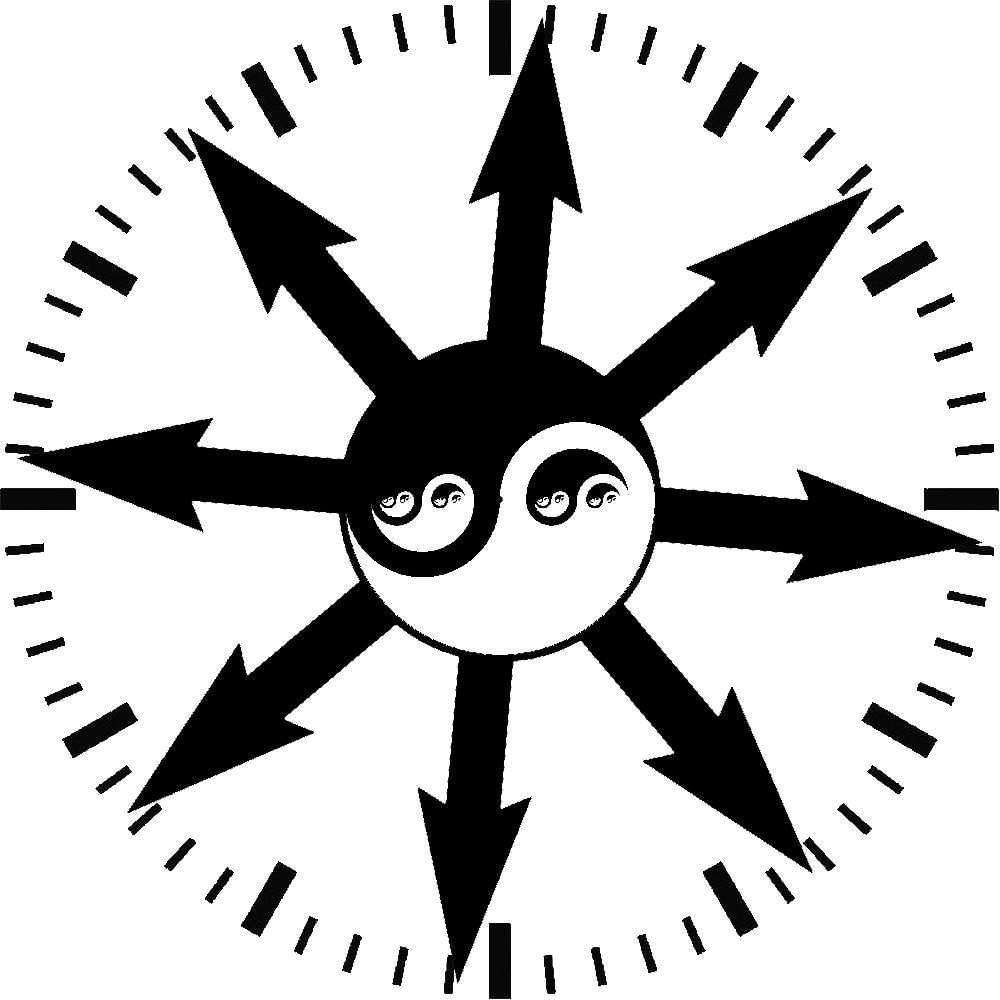
Note 2025-07-29: I need to update this one a bit for small changes to the “Chaos-Kia Table” (below as “Kia Chart”) and the “Five by Eight Table”. The below is fine though.
This one I pieced together from elements I found on Google. I do not have the references for the original sources for the recursive yin-yang/taijitu, off-center chaos star, and unmarked clock face. If any of the original designers request I will take this one down.
I “used” this pretty extensively at least thinking about it and looking at it, over a decade ago, peaking around the summer of 2012. I call it the “time bubble sigil,” and leading up to one of my hospitalizations I was hearing voices in my head saying “he’s doing x baktuns a second/minute/etc.” The idea I guess being a sort of occult temporal relativity linked to time compression and expansion, itself related to the idea of “mythic space,” where different locations (even right next to each other if articulated by a liminal space like the doorway or stairs or entering or leaving a forest or some other transition) sort of became imaginally untethered or unlinked, ideally existing in their own “pocket dimension” (to borrow a term from the game Starbound). This was all part and parcel to the ritualization of day to day life which at the time ultimately probably contributed to me losing my mind, yet again.

This one I go into greater detail in the post Email to Peter J. Carroll. From that post:
Elements (Classical – Materialist; each item is defined by the other four):
- 🜁 Air – Space
- 🜄 Water – Time
- 🜃 Earth – Mass
- 🜂 Fire – Energy
- ☉ Aether (Sun Symbol) – Mind (Psi (Ψ; parapsychology) & Phi (Φ; Integrated Information Theory))
Elements of the “Pe0” Sigil:
- ☯ Taijitu – Taoist Yin & Yang Symbol
- ☸ Dharmachakra – Buddhist Dharma Wheel
- ✵ Chaos Star – Symbol of Chaos (black circle with 8 arrows extending outwards)
- 🜏 Leviathan cross – Satanic Cross (Sulphur symbol)
- = Equals Sign
- ∞ Infinity Sign
- Φ Phi – Philosophy, Quantum Wave Function, Integrated Information Theory (IIT), Panpsychism
- Ψ Psi – Psychology, Parapsychology
- X Pe – “X” with circles at the ends, letter from the Malachim magical alphabet, often associated with angelic magic
At first I was calling this the symbol for the “Omni-Buddha” (“Omni” sounds like “Amida”, right? Last time I was kind of going crazy I found this meaningful), or, the one highest primordial cosmic demon-buddha whose emanations are all the activity and phenomena of the Omniverse*. Later I decided this was silly and decided to attribute the sigil to Pe (or “Pe0”), and the simple Pe letter sigil above would represent “Pen”, or any number n of subsidiary servitors generated by “Pe0”.
* I’ll further note that this would correspond to the “Demiurge” of the Omniverse, the Omniurge, and each universe in the Omniverse would be created by and be identical with, its own respective Demiurge. In the 10 key dimensions of the Imagining the Tenth Dimension (10THDIM) model, this would equate to a being for each point in the space formed by dimensions seven through nine. Further, each snapshot in time of the state of a given universe in dimensions four through six would also be a being, and each point in space would be a being, too. I don’t have special terms for these but maybe Chronurge for time and Chorourge for space would suffice. Finally, as I write in different posts on here, I consider every possible set of cosmological information in at least 10 dimensions (the 10 “key” dimensions, as there may be additional very large or very small dimensions, or dimensions of curvature, or dimensions implied by theoretical physics and so on) to be a being, including null, universal, and random sets. It is from the interaction of all these dynamic chaotic beings that “rational” form and the world of physical laws and cosmic habits emerges, in other words some “beings” interact in more consistent ways, or are more connected to each other than others, or “make more sense.” A tree for example “makes more sense” than a random sampling of atoms from throughout the universe, but both are beings, as I see it. I refer to this as a kind of multimind panpsychic panentheistic neo-animism.
I don’t remember my intention for this one, which is generally good practice for chaos magick sygaldry/sigilization, but I don’t visualize or charge it very frequently. I hope it was something good, I do intend to return to it.
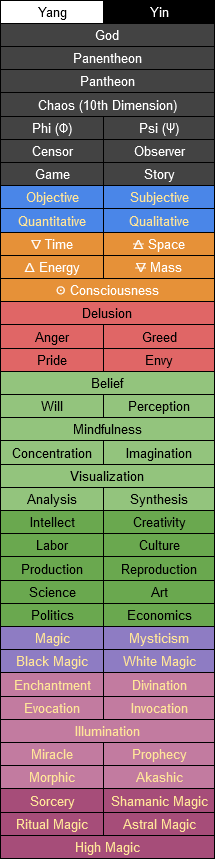
This chart more or less loosely groups or unifies different elements and concepts, at different levels of analysis, from cosmology (at least, my personal religious/spiritual cosmology), existence, psychology (Buddhism and Chaos Magick), culture and sociology, mysticism and magick, and “advanced esoteric states” or levels of attainment. Broadly categorized under Yin, Yang, or straddling Both (relative to other related elements), we start with God, the Panentheon, and the Pantheon.
God, as I conceive of Them, is impossible to conceive of, in large part because of the panentheistic view that God “encompasses and surpasses” Reality and the Cosmos. All sets of cosmic data are beings, and all these beings are the “Pantheon”. They may under certain circumstances be ranked as “entities, beings, and persons,” but this is a bit unfair and unnecessary in an ultimate sense because as I see it a being is a being. Yet, I’m more loyal to beings I perceive as capable of deep, broad, complex, complicated, varied, novel, subtle, and nuanced levels of life and consciousness, existence and experience, and beingness, meaningfulness, and happiness (and therefore damage, destruction, pain, suffering, harm, and death, especially including poverty, illness, injury, hypothermia, hyperthermia, hunger, and thirst). I’m also simply loyal to humanity, regardless of considerations or analysis of a person’s intellect. Humans are equal. But, in general, while a being is a being, I see humans and other conscious and sentient creatures as persons, “simpler” creatures as beings, and maybe a cosmological “random set” as an “entity.”
In any case, the Panentheon is the expansion of “God” (as we can grasp at understanding Them) into “God = God + Pantheon = Panentheon”.
The rest of this section I go into greater detail in the post The PSI-PHI Matrix (PPM).
From there we have the analytical dualistic categories of quality and subjectivity vs quantity and objectivity.
Moving on we have the Peter J. Carroll’s “Materialist Elements” found in Liber Kaos, with some slight modifications by me. I move his “Aether” back onto the Classical Elements side, expand it into Yin and Yang Aether, and then replace it on the Materialist Elements side with Psi/Phi (Consciousness/Information).
Next we have the five Buddhist “defilements”. There are actually hundreds of identified defilements, but they all spring from these five. The root defilement is “delusion” (ignorance, wrong view), chiefly reification, chiefly reification of Self/Other (I should add Self and Other to this table, I just realized). From these spring “greed” (craving, desire to be closer to and have more of a thing), and “anger” (aversion, desire to be further from and have less of a thing). From these three (delusion, greed, anger) spring “pride” and “envy,” and from these five all of the rest.
Next are basic operations or magical traits Carroll attributes to the Kia or soul, which inherits these properties and powers from Chaos (the God of Chaos Magick, if you will). Inspired by a plurality of different religious/spiritual, mystical/magickal, and occult/esoteric traditions, and specifically Chaos Magick itself, I take belief from merely being a tool for magickal praxis (“arbitrary belief”, “paradigm shifting”) and insert it at the fundamental root of Kia, from which “will” and “perception” spring. (I also add “mindfulness” to this section.) As the basic Buddhist defilements interact to generate more complex defilements, the interactions of belief, will, and perception generate the rest of the “basic operations”/”traits”/”powers”. Most of these traits then correspond to the classical magical operations in the second to last section of the table (enchantment, divination, evocation, invocation, and illumination, where “miracle” and “prophecy” are advanced states and/or levels of ability and attainment with regards to these five operations).
But perhaps it is better to quote Carroll himself. From the introduction to my post Email to Peter J. Carroll:
Basic Operations:
Will, Perception, Analysis, Synthesis, Concentration, Imagination, Visualization (and Mindfulness)
Classical Magical Operations (Peter J. Carroll, Liber Kaos):
- Enchantment: “Includes all those practices in which the magician attempts to impose will on reality.”
- Divination: “Includes all those practices in which the magician attempts to extend perception by magical means.”
- Evocation: “This is work with entities that may be naturally occurring or manufactured. The entities may be regarded as independent spirits, fragments of the magician’s subconscious, or the egregores of various species of life forms, according to taste and belief structure. In practice, evocation is usually performed for enchantment, in which the evoked entities are made to create effects on behalf of the magician. Evoked entities also find some application in divination, when they are used to discover information for the magician.”
- Invocation: “This is the deliberate attunement of consciousness with some archetypal or significant nexus of thought. … Invocation creates states of inspiration or possession during which enchantment, divination, or occasionally evocation, can be performed.”
- Illumination: “Is deliberate self-modification by magic, and may include spells of enchantment cast at one-self to repair weaknesses or increase strengths, and divination and invocation performed for inspiration and direction.”
Next I list and associate some human sociological behaviors and traits. I may update this table to put labor as at the root of this section, before intellect and creativity (and spanning yin/yang), and also expand culture to cross both columns but in its present location below/subsequent to intellect and creativity.
Magic(k) (I’ve lately come to appreciate the “k” at the end of magick) is more active and willful, concerned with action and results. Mysticism is more passive and perceptual, concerned with the path and purification. Both in their own ways seek integration with the greater, hidden reality. Black magick and white magick are also like this, but are further specific subdivisions of magick.
Enchantment is the magickal activity of the will, divination is the magickal activity of perception, evocation is creating (internal, smaller) thoughtforms while invocation is tapping into (external, greater) thoughtforms or pools of information/energy. Evocation corresponds to analysis and imagination, invocation to synthesis and concentration.
The entropy both in terms of complexity and volume of matter over space/time complicates enchantment and divination in opposite ways: divination becomes more difficult and less precise, effective, or useful over greater distances and durations, whereas enchantment is more difficult and less precise, effective, or useful over shorter durations (though the increased difficulty caused by greater distances holds). The more space, time, mass, energy, information, and consciousness, the more dynamic, complex, and complicated the system becomes, so getting specific knowledge is hindered, whereas these processes actually support modifying ones mind, probabilities, and reality in general.
The expression goes, “divine short, enchant long.” It is easier to gain useful information about the present moment than to gain useful information about events a century from now, whereas a magickal spell of enchantment needs some time to cook. (To resolve the imbalance regarding larger systems appearing not to facilitate enchantment, we can look to the post B.U.T.T.S. DLC to see how synchronizing and integrating local systems with larger systems may increase enchantments’ efficacy.)
Prophecy and Miracle are levels of attainment and ability where the adept can “enchant short and divine long,”: miracles are rapid or instant enchantments, and prophecy is accurate knowledge over vast times and distances.
Integral to Carroll’s concept of Aether, (for me Psi (Consciousness)/Phi (Information) corresponding to Yin/Yang Aether) is its character of being a field that permeates the whole universe, which is accessible instantaneously anywhere in the universe within a single moment, and has the “morphic” property. I add the popular “akashic” property to balance it out, and extend it to the 10 key dimensions. The morphic (or morphogenic, or morphogenetic) field refers to the tendency of the cosmos to “remember” and reproduce forms which have come into being more or less randomly, on their own, or in an emergent fashion. These shapes and forms, once they exist for the first time, become more likely to spontaneously regenerate elsewhere. They have direct “descendants” and indirect ones with which they don’t directly interact or whom they don’t directly spawn, yet which inherit some, much, most, or all of their properties or riff on them adaptively and iteratively, introducing variation to the continuity. (This process also relates to the Omniurge, Demiurge, Chronourge, Chorourge and multimind panpsychic panentheistic neo-animism hypothesis I believe in.)
As I see it, the active element that drives this process is the Morphic Field, and the “memory” or storehouse of all the cosmic information in at least 10 dimensions is the Akashic Field, but ultimately they both are properties of one integrated field.
Finally, we have Carroll’s Levels of Magic (I might move “miracle” and “prophecy” after “high magic,” but there’s arguments for moving it and leaving it where it is). From the post Email to Peter J. Carroll:
Levels of Magic (Peter J. Carroll, Liber Kaos):
- Sorcery: “Simple magic that depends on the occult connections which exist between physical phenomena is called sorcery. It is a mechanical art which does not require the theory that connections exist between the mind of the operator and the target.”
- Shamanic Magic: “This works on the level of trance, vision, imagination and dream. It opens the magician’s subconscious by negating psychic censorship with various techniques.”
- Ritual Magic: “Combines the abilities developed on the sorcery and shamanic levels.”
- Astral Magic: “This magic is performed by visualization and altered states of consciousness, or gnosis, alone.”
- High Magic: “High magic is that which occurs when there is no impediment to the direct magical effect of will, no barrier to direct clairvoyance and prescience, and no separation between the magician and any form of rapport or consciousness he or she chooses to enter into.”

This table draws correspondences to eight categories of elements, mostly from Liber Kaos, with some slight modifications and additions by me (though not necessarily original to me, for example the correspondence between the playing card suits/dice and magical weapons, though choosing dice, specifically 2d6, instead of the Joker, was a personal choice). I usually choose to spell “ether” as “aether,” because I like it better, and I would add “Phi” to “Psi”.
This table is something I’ve been interested in incorporating into a pen and paper/tabletop role-playing game (TTRPG). I haven’t made much progress, but I have some ideas still kicking around.

 Tuck Detchon Writes
Leave a reply to README – Tuck Detchon Writes Cancel reply