

Update
I wrote a new post that slightly updates this one, and also recapitulates it in a much sorter read time(~5 minutes versus this one’s ~47 minutes): Patch Notes 02 – PPM.
Introduction
In Chaos Magic, beliefs are not seen as ends in themselves, but as tools for creating desired effects. … The purpose of Chaos rituals is to create beliefs by acting as though such beliefs were true. In Chaos Rituals you fake it till you make it, to obtain the power that a belief can provide. … It takes only the acceptance of a single belief to make someone a magician. It is the meta-belief that belief is a tool for achieving effects. (Peter J. Carroll, Liber Kaos)
Truly I tell you, if you have faith as small as a mustard seed, you can say to this mountain, ‘Move from here to there,’ and it will move. Nothing will be impossible for you. (Matthew 17:20 NIV)
To see a World in a Grain of Sand
And a Heaven in a Wild Flower,
Hold Infinity in the palm of your hand
And Eternity in an hour. (William Blake, “Auguries of Innocence”)
A truth; no doubt it is true. Indeed, the uppermost is from the lowermost and the lowermost is from the uppermost. It worked the wonders from one, just as all things come from one by means of one plan. Its father is the sun, its mother is the moon. The wind carried it in her womb, the earth fed it. Father of talismans, keeper of wonders, perfect in power. Fire became earth, separate the earth from the fire. The subtle is more noble than the gross. With gentle-being and wisdom it ascends from the earth to the heaven and descends to the earth from the heaven. And in it is the power of the uppermost and the lowermost. Since with it is the light of lights therefore the darkness escapes away from it, power of powers. It prevails over everything subtle, enters into everything gross. Against the creation of the macrocosm the work was created … . (pseudo-Apollonius of Tyana, The Secret of Creation and the Art of Nature, translated by Wikipedia)
When you make the two into one, and when you make the inner like the outer and the outer like the inner, and the upper like the lower, and when you make male and female into a single one, so that the male will not be male nor the female be female, when you make eyes in place of an eye, a hand in place of a hand, a foot in place of a foot, an image in place of an image, then you will enter the Father’s domain. (Gospel of Thomas, The Complete Gospels (3rd edition), ed. by Robert J. Miller, qtd. by PBS)
This post describes the “PSI-PHI Matrix,” (PPM), which is the system of relationships among Psi (Ψ), Phi (Φ), the Observer, and the Censor. The PPM interfaces directly with the Void, Chaos, Kia, and Gnosis of Chaos Magic, and these together with the PPM form the “Core” of Mythic Meta-Gamification (MMG) and the OpenCult. The Core is fundamental to the “Kernel” (10THDIM-DIAMAT-CMT), and the Kernel is fundamental to the MMG “Shell” of OpenCult, which is an “invented religion” or “arbitrary belief paradigm.”
OpenCult is basically a flavor of Chaos Magic which leans heavily into the “invented religion” descriptor and the characterization of Chaos Magic and Marxism as religions (usually by their detractors, and despite their atheism and materialism). Rob Bryanton’s Imagining the Tenth Dimension project has also been criticized as religious or cultish (it’s not). All three have been labeled as pseudoscience at one point or another, which is fine for our purposes. There are limits to Science specifically and knowledge in general. As such, the belief system I’m developing here is speculative, unscientific, and falls under the category of religion/spirituality and the occult. I will argue my conjectures and leave it to the reader what to accept or reject.
Science describes the least of things. The least of what something is. Religion, magic—bows to the endless in everything, the mystery. (Liam Gavin, A Dark Song (Film, 2016))
OpenCult is an anti-cult, or, anti-authoritarian and anti-hierarchical, anti-dogmatic, openly invented religion, which I have been tinkering with on and off for a few years now. If anyone ever adopts it, it should be distributed and decentralized.
Arbitrary belief originates from Chaos Magic, as written about by Peter J. Carroll in Liber Null & Psychonaut, Liber Kaos, and other works. Chaos Magic is the primary influence on OpenCult, and is sometimes considered an invented religion in its own right. There are well reasoned strains of thought that say time, the self, and free will qualify as illusions but, usually, we rely on belief in these apparent fictions to live our daily lives. That said, arbitrary belief isn’t simply the practice of believing what is practical and useful in day to day life, or for psychological aid in achieving your life goals; it centers belief as a symbolic language between the self and the subconscious for personal change (“illumination”), and between the subconscious and reality for the direct application of will and perception on worldly events and outcomes (“results”), as well as “turning around” results on illumination (applying the parapsychological to the psychological).
(As per Liber Kaos, Will, Perception, Concentration, Imagination, Visualization, Analysis, and Synthesis are the “Magical Traits” in Chaos Magic, and Enchantment, Divination, Evocation, Invocation, and Illumination are the “Classical Magical Operations.” We will save explanations of the operations for another post.)
Mythic Meta-Gamification is “heroic life story gamification,” or narrativizing life itself as a hero’s journey, and from there imagining it as a game to be played and won. It barely resembles Campbell’s “Hero’s Journey,” and more directly takes inspiration from the inherent human narrative drive as well as narrative culture e.g. the actual existing genres of myth, folklore, legend, fiction and nonfiction literature, film, television, tabletop games, and video games, etc. in general. In a word, Story — but here we are mindfully intervening in the stories we tell ourselves about ourselves, each other, and the world we live in, to immerse ourselves in the experience of magic and mysticism, and all of this to advance the cause of Communism — “the abolition of exploitation and oppression of groups by groups.” We are mindfully merging the processes of descriptive and inventive cultural storytelling with the basic and omnipresent social and cognitive processes of narrativizing our models and schemas which we consciously and largely unconsciously use to contextualize and orient ourselves in the world: “Who am I? Who are we? What is happening? What is everything?” etc.
We all know what heroes and their quests are, and if we don’t, intentionally exploring that is a central mechanic of MMG — as is actively “gamifying” life, where conscious gamification is part of the gameplay itself, a dimension to the magic of the belief system. One of the main “moves” within The Game is the narrative re-contextualization of phenomena and experiences as gameplay.
The Kernel of MMG, is, as stated above, 10THDIM-DIAMAT-CMT:
- 10THDIM: Rob Bryanton’s Imagining the Tenth Dimension model as outlined in Imagining the Tenth Dimension: A New Way of Thinking About Time and Space
- DIAMAT: Marxist Dialectical Materialism
- CMT: Peter J. Carroll’s “Chaos Magic Theory” as outlined in Liber Kaos
Without abbreviation, the Kernel would be called “Tenth Dimensional Dialectical Materialist Chaos Magic Theory.”
The Kernel is inspired by the basic dialectical formulas attributed to Hegel:
- Thesis → Antithesis → Synthesis
- Problem → Reaction → Solution
- Abstract → Negative → Concrete
The Kernel also tries to incorporate, along with Dialectics and Dialectical Materialism in general, Engels’s Three Laws of Dialectical Materialism (DIAMAT):
- The law of the unity and conflict of opposites
- The law of the passage of quantitative changes into qualitative changes
- The law of the negation of the negation
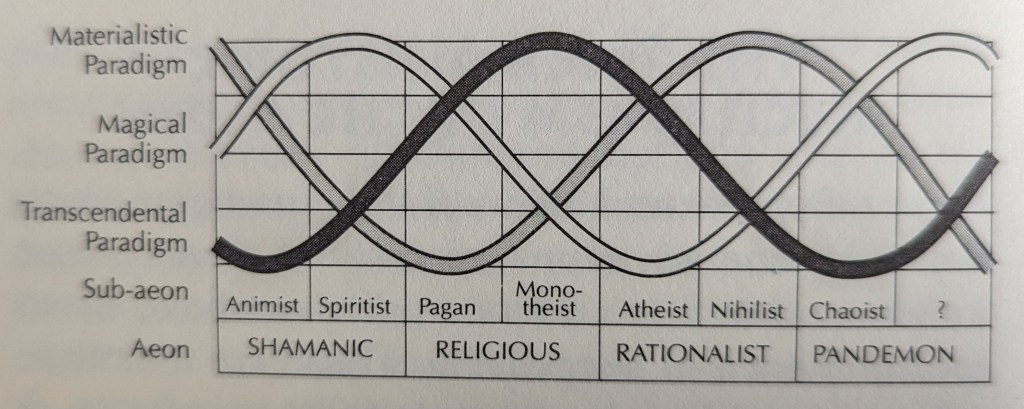
The Kernel’s three components also represent the three major categories of Aeonic Psychohistory Paradigms found in Peter J. Carroll’s Liber Kaos:
- 10THDIM: Transcendental (secondary: Materialistic)
- DIAMAT: Materialistic (secondary: Transcendental)
- CMT: Magical (secondary: Materialistic)
This acquires added significance because there is a direct resonance between CMT and DIAMAT where the evolution of the history of the Class Struggle (Historical Materialism) and Aeonic Psychohistory are both in a sense catalyzed by the technical advancement of the implements of social production i.e. technology and the economy. Here the Class Struggle might be categorized as the Base and Aeonic Psychohistory as an element of the Superstructure.
(The concept of the Base and Superstructure is a (Dialectical) Historical Materialist model illustrating the recursive mutual conditioning or virtuous cycle of material conditions, i.e. politics and the economy, and ideology.)
Thenceforward, however, the development of the sciences proceeded with giant strides, and, it might be said, gained in force in proportion to the square of the distance (in time) from its point of departure. It was as if the world were to be shown that henceforth the reciprocal law of motion would be as valid for the highest product of organic matter, the human mind, as for inorganic substance. (Frederick Engels, Dialectics of Nature)
Since the historical three phase oscillation of the three Aeonic Paradigms accelerates along with accelerating culture/technology (as per Moore’s Law and Kurzweil’s “Law of Accelerating Returns,” which Engels describes in the above quote dated 1883), it follows that at a certain point they will cycle so fast as to be effectively simultaneous: their periods will be very short—instead of historical scales of time, several or many cycles (or “Sub-Aeons” and “Aeons”) will occur within one lifetime, or even one decade, one year, etc. Therefore, a system that incorporates all three of the Aeonic Paradigms will be appropriate (if it is not already appropriate for these very times). Carroll, in Liber Kaos, criticizes approaches which include or emphasize all three of the main paradigms at once, in other words combine the Materialistic, Magical, and Transcendental paradigms within one system. We’re doing it anyway for a few reasons, not the least of which is the Aeonic acceleration we’ve just addressed.
(In the physics-inspired language of 10THDIM, the Class Struggle and Aeonic Psychohistory represent the “entangled” “choice and chance” selected from branching timelines by the Observer, or rather, plural observers.)
The main ideas and values OpenCult appropriates from Chaos Magic are syncretism, experimentation and individualization, anti-dogmatism and antinomianism, arbitrary belief, Void/Chaos/Kia, Gnosis, Chaos Magic Theory (CMT) and Magic Factor, the Materialist Elements, and the Aeonic Psycho-History model. Void, Chaos, Kia, and Gnosis are closely interrelated with Psi, Phi, Censorship, and Observation (the PPM).
The unity which appears to the mind to exert the twin functions of will and perception is called Kia by magicians. Sometimes it is called the spirit, or soul, or life force, instead. … Kia is capable of occult power because it is a fragment of the great life force of the universe. … The “thing” responsible for the origin and continued action of events is called Chaos by magicians. … Chaos … is the force which has caused life to evolve itself out of dust, and is currently most concentratedly manifest in the human life force, or Kia, where it is the source of consciousness. … To the extent that the Kia can become one with Chaos it can extend its will and perception into the universe to accomplish magic. (Peter J. Carroll, Liber Null & Psychonaut, quoted by Wikipedia, “Kia”)
In short, the Void-Mind conceives of Chaos, Chaos bridges formlessness and the most universal cosmic level of form, 10-dimensional Psi, whose innate property inherited from the Void and Chaos, Observation, once divided up and restricted by Censorship, provides the seeds of consciousness or Kia realized in Phi (which we experience as incarnate sentiences) and its own level of Observation and Censorship:
Void
↓
Chaos
↓
Psi
↓
Observation
↓
Censorship
↓
Kia
↓
Phi
↓
Observation
↓
Censorship
↓
Gnosis
↓
YOU ARE HERE
Alternately:
Void (Mind) → Chaos (Trance) → Psi (Spell) → Kia (Illusion) → Phi (Ghost)
The pre-geometric Void includes and exists beyond time and space. Zero isn’t empty, it is filled with opposing values and forces which appear to “cancel each other out,” but random, relative fluctuations of the Void give rise to Chaos, “the formless matter supposed to have existed before the creation of the universe,” (Oxford Languages, via Google, “Chaos”). From this “formless matter” springs the 10-dimensional structure of Psi, which conserves and directly transmits the potency, from Void-Chaos, of the Observation property (will and perception), via its relative restriction or “Censorship”, as Kia, or, a “part” of Chaos present in all subsequent, simpler or “dimensionally lower” matter (via and relative to 10th dimensional Psi), or, Phi. Phi, then, represents the computational and structural integration of material forms (systems) “down here” in spacetime, in which Psi/Kia, having been divided from itself and bottled up in every 0-dimensional point making up the entire 10-dimensional structure of the Omniverse, is harmonized with itself in order to support the evolution of the “level” of consciousness which we experience as beings. Phi “reaches back up” towards Psi through Gnosis, or inhibitory and excitatory trances.
The Void is the all-mind, non-dualistic, formless, timeless, containing everything. Chaos is the content of this mind, the self-cognition of the Void, which casts the Omniverse (Psi) as a magic spell which creates the illusions of the reality we experience through the illusory separateness (Kia) from the source of that reality, and ultimately, the experience of being an embodied “self”, or ghost.
For the purposes of this post, though, we will focus mainly on the PPM:
- Psi
- Psi-Observation
- Psi-Censorship
- Phi
- Phi-Observation
- Phi-Censorship
But first, we will briefly address Dialectics and Panpsychism.
Dialectical Materialism
Dialectics comes from the Greek dialego, to discourse, to debate. In ancient times dialectics was the art of arriving at the truth by disclosing the contradictions in the argument of an opponent and overcoming these contradictions. There were philosophers in ancient times who believed that the disclosure of contradictions in thought and the clash of opposite opinions was the best method of arriving at the truth. This dialectical method of thought, later extended to the phenomena of nature, developed into the dialectical method of apprehending nature, which regards the phenomena of nature as being in constant movement and undergoing constant change, and the development of nature as the result of the development of the contradictions in nature, as the result of the interaction of opposed forces in nature. (J.V. Stalin, Dialectical and Historical Materialism)
When we consider and reflect upon nature at large, or the history of mankind, or our own intellectual activity, at first we see the picture of an endless entanglement of relations and reactions, permutations and combinations, in which nothing remains what, where, and as it was, but everything moves, changes, comes into being and passes away. We see, therefore, at first the picture as a whole, with its individual parts still more or less kept in the background; we observe the movements, transitions, connections, rather than the things that move, combine, and are connected. This primitive, naive, but intrinsically correct conception of the world is that of ancient Greek philosophy, and was first clearly formulated by Heraclitus: everything is and is not, for everything is fluid, is constantly changing, constantly coming into being and passing away. (Frederick Engels, Socialism: Utopian and Scientific)
In philosophy, categories are extremely general, fundamental concepts reflecting the most essential, law-governed connections and relationships of reality. … The categories are universal and lasting because they reflect what is most stable in the universe. Moreover, in the process of history the content, role and status of the categories change and new categories (system, structure, for example) arise. … The categories bear a certain relation to one another and constitute a system. They are so interconnected that each can only be understood as an element of the whole. The initial categories for the whole system are those of matter and consciousness. They provide the trunk from which all the various branches of the other categories stem. (Alexander Spirkin, Dialectical Materialism)
DIAMAT as an abbreviation originates with the take on Dialectical Materialism built into Marxism-Leninism, which was synthesized/codified by Stalin. Combining Dialectics and Materialism and applying them to the history of society, we find that the Ideal (or mental, psychic, or spiritual life of society) is the secondary “reflection” of the Material (although the Material is primary and includes the Ideal, and also precisely because of this same reason, the Ideal and the Material mutually condition each other, for example in the base-superstructure relationship). Dialectics is complicated, and unfortunately Marx was never able to finish his planned work explaining his dialectical method in detail, but as per the quotes above, in general dialectics views all things as interdependent and mutually conditioning dynamic processes, characterized by the internal and external “contradictions” which drive the evolution and change of all entities and phenomena.
In the introduction we saw three characterizations of Hegel’s method, and Engel’s three laws of Dialectical Materialism. Stalin summarizes DIAMAT as such:
- Nature is connected and determined [via cause and effect processes and relationships].
- Nature is a state of continuous motion and change.
- Natural quantitative change leads to qualitative change.
- Contradictions are inherent in nature.
We speculate that the “Chaos” in “Chaos Magic” can be seen as identical with the “Dialectic” of “Dialectical Materialism”. This is another point of unity among the 10THDIM-DIAMAT-CMT syncretic arbitrary-belief elements.
In DIAMAT, the brain is regarded as “the organ of thought,” and the mind, produced by the brain, is seen as somehow subordinate to matter or material conditions. DIAMAT, viewing nature and matter as primary, opposes “Idealism”:
Contrary to idealism, which regards the world as the embodiment of an “absolute idea,” a “universal spirit,” “consciousness,” Marx’s philosophical materialism holds that the world is by its very nature material, that the multifold phenomena of the world constitute different forms of matter in motion, that interconnection and interdependence of phenomena as established by the dialectical method, are a law of the development of moving matter, and that the world develops in accordance with the laws of movement of matter and stands in no need of a “universal spirit.” … Contrary to idealism, which asserts that only our consciousness really exists, and that the material world, being, nature, exists only in our consciousness, in our sensations, ideas and perceptions, the Marxist philosophical materialism holds that matter, nature, being, is an objective reality existing outside and independent of our consciousness; that matter is primary, since it is the source of sensations, ideas, consciousness, and that consciousness is secondary, derivative, since it is a reflection of matter, a reflection of being; that thought is a product of matter which in its development has reached a high degree of perfection, namely, of the brain, and the brain is the organ of thought; and that therefore one cannot separate thought from matter without committing a grave error. (J. V. Stalin, Dialectical and Historical Materialism)
It is impossible to separate thought from matter that thinks. Matter is the subject of all changes. … The material, sensuously perceptible world to which we ourselves belong is the only reality. … Our consciousness and thinking, however supra-sensuous they may seem, are the product of a material, bodily organ, the brain. Matter is not a product of mind, but mind itself is merely the highest product of matter. (Marx, Selected Works, Vol. I, qtd. in J.V. Stalin, Dialectical and Historical Materialism)
Matter is that which, acting upon our sense-organs, produces sensation; matter is the objective reality given to us in sensation. … Matter, nature, being, the physical — is primary, and spirit, consciousness, sensation, the psychical — is secondary. … The brain is the organ of thought. … Materialism in general recognizes objectively real being (matter) as independent of consciousness, sensation, experience. … Consciousness is only the reflection of being, at best an approximately true (adequate, perfectly exact) reflection of it. … The world picture is a picture of how matter moves and of how “matter thinks.” (Lenin, Vol. XIII, qtd. in J.V. Stalin, Dialectical and Historical Materialism)
Contrary to idealism, which denies the possibility of knowing the world and its laws, which does not believe in the authenticity of our knowledge, does not recognize objective truth, and holds that the world is full of “things-in-themselves” that can never be known to science, Marxist philosophical materialism holds that the world and its laws are fully knowable, that our knowledge of the laws of nature, tested by experiment and practice, is authentic knowledge having the validity of objective truth, and that there are no things in the world which are unknowable, but only things which are as yet not known, but which will be disclosed and made known by the efforts of science and practice. (J. V. Stalin, Dialectical and Historical Materialism)
When combined with Panpsychism, Dialectics becomes more powerful than you can ever possibly imagine.
Panpsychism
Panpsychism, specifically Materialist (or “Physicalist”) Panpsychism, instead of placing matter above consciousness, or consciousness above matter, posits that matter, in a very literal way, is consciousness, and vice versa. In some sense it is both true that reality, or matter, exists outside of our own individual minds whether we “are looking” or not (i.e. “without us”), but also that all matter is conscious and that mind is on the same fundamental level as matter. (But mind and matter being identical, they both obey the same discoverable and knowable laws governing reality.)
Consciousness isn’t exclusively the product of an extremely specialized and specific shape and combination of different types of matter, although, as we’ll see below in the section on Phi, this specialization is a factor in the informational, computational, or structural “integration” which, as it scales quantitatively, supports higher qualitative levels of experience and awareness (or rather, this integration is experience), whereas most “dead” (or maybe sleeping) matter has very low levels of integration and therefore has no more than basic feeling.
Panpsychism is the philosophical view that consciousness is a fundamental and ubiquitous aspect of the universe. According to this perspective, all physical entities, from the smallest particles to the largest structures, possess some form of consciousness or experiential quality. This doesn’t imply that every object has human-like awareness, but rather that there is a basic form of consciousness intrinsic to all matter. (ChatGPT)
[T]he highest product of organic matter, [is] the human mind … . (Frederick Engels, Dialectics of Nature)
The brain is the organ of thought. … The world picture is a picture of how matter moves and of how “matter thinks.” (Lenin, Vol. XIII, qtd. in J.V. Stalin, Dialectical and Historical Materialism)
These last two quotations suggest that all consciousness, including that enjoyed by humans and other animals, only emerges after millions and billions of years of evolution of the nervous system from simpler life, chemical, and physical processes. The argument goes that consciousness is an “emergent property” confined to a narrow range of very specific causes only found in the brain, and that thought and experience only occur in the brain.
Panpsychism argues that all matter feels something, even if it is very basic, and that consciousness is the “intrinsic nature” of all matter (matter equals consciousness, consciousness equals matter), and that it is in a sense dualistic to say that the brain, made up of the same ingredients as the rest of the universe, bears the special property of consciousness while the rest of the “dead” matter in the universe does not.
We receive this criticism from a view promoted by Philip Goff, who writes about it in his book Galileo’s Error: Foundations for a New Science of Consciousness. The main thrust of the argument as I understand it is as follows. Physical science, since Galileo, has been objective and quantitative, concerned with understanding and describing phenomena in terms of observation by the senses, measurement with tools, and definition by mathematics. Yet, all the units and properties etc. of physical science are defined in terms of one another, in other words, they are circular: if you keep defining scientific concepts in terms of each other, eventually you will wind up where you started. Thus, we know nothing about the “intrinsic nature” of matter, what it fundamentally is. In all this hubbub about objective quantities, we’ve lost the subjective-qualitative forest for the trees.
Goff points out that consciousness is the one thing we absolutely know is real — even if we lack certainty about whether others are also conscious, if there is an ultimate reality at all, if the future will resemble the past, or even if we are in a simulation or our brains are in jars somewhere hallucinating reality, the experience itself is “its own datum.”
From there Goff patiently and systematically builds toward the view that consciousness is the intrinsic nature of matter — that matter IS consciousness, and consciousness IS matter, beyond even saying that mind is a property of matter, or that matter gives rise to consciousness under a narrow set of special, specific conditions and circumstances. Carroll, in The Apophenion, explains that in the panpsychic view, consciousness is a fundamental property of all matter, not merely an effect produced by a narrow set of specific conditions, such as the appearance of a rainbow under certain relatively rare atmospheric conditions in certain kinds of atmospheres. Goff points out that it is dualistic to privilege brain matter as unique when compared to all other matter; materialists believe that everything is matter, and that the brain is merely matter, and that thought is merely “how ‘matter thinks’” — the adaptation of Panpsychism used here agrees with DIAMAT that matter thinks, but extends the dialectical nature of all matter to include the property of consciousness.
This isn’t quite traditional Idealism in the sense that “all experiences are solely produced by the mind, and that matter doesn’t exist independently of the mind.” As we are thinking here (though maybe not as proposed by Goff and others), it is Idealist in the sense that reality and matter are the computational and cognitive information processing of some cosmic Mind.
The self-cognition of God, or the Void, or what have you.
DIAMAT might also help illuminate this subject with its stance that things, such as mind and matter, ideal and material, objective and subjective, and quantitative and qualitative, are and are not themselves, can be their opposites, or, become their opposites, and so share an identity or “interpenetrate” each other, as per Engels’s Three Laws of Dialectical Materialism (DIAMAT), which again, are:
- The law of the unity and conflict of opposites
- The law of the passage of quantitative changes into qualitative changes
- The law of the negation of the negation
Goff and Bryanton, in their respective books cited above, invoke the Quantum Observer interpretation of Quantum Mechanics (QM), which has been discredited, wherein the view is that a conscious being such as a human or animal is necessary to resolve probabilistic wave functions representing an array of possible states into a specific outcome (“collapsing the wave function”). I think this view can be rehabilitated and squared with accepted QM interpretations by Panpsychism: literally every possible system in, let’s say, 10 dimensions, is an Observer, so the accepted stance that “observer means physical interactions of particles and systems of particles,” becomes trivially compatible with the Quantum Observer interpretation of QM.
Here, the 10-dimensional computational/cognitive system is “Psi”.
Psi (Ψ)
“Psi” (Ψ) is the 23rd letter of the Greek alphabet, and is used as the symbol representing a quantum wave function, as the symbol of the field of psychology, as well as to represent the hidden variable behind parapsychology.
Parapsychology is the study of alleged psychic phenomena (extrasensory perception, telepathy, precognition, clairvoyance, psychokinesis (also called telekinesis), and psychometry) and other paranormal claims, for example, those related to near-death experiences, synchronicity, apparitional experiences, etc. … In parapsychology, psi is the unknown factor in extrasensory perception and psychokinesis experiences that is not explained by known physical or biological mechanisms. (Wikipedia, “Parapsychology”)
Parapsychology and related effects are usually conceived of as an extension of the human mind, from the causal (worldly events are connected by physical relationships and interactions) into the acausal (worldly events are connected by meaning). That is, sometimes physical brains/minds can do strange, magical, and/or mystical things via a hidden, paranormal medium or process.
The secret ingredient in this recipe is called “Psi.”
Below, I will argue almost the reverse, that Psi is actually the basis of ALL of reality, not just a small part of reality responsible for psychic powers etc. Psi as the hidden element responsible for unexplained parapsychological effects is also responsible for the unexplained existence and operation of the Cosmos, and of life and consciousness within it. Psi encompasses both mind and matter, that is, subjectivity and quality, and objectivity and quantity, at all levels of Rob Bryanton’s 10-dimensional model of the Omniverse.
Rob’s 10 dimensions are, an arbitrary point (0D), space (three dimensions), time (and probability-space and phase-space; three more dimensions), multiverse (three more), and the whole thing treated as a single point, or, the Omniverse (10D):
“Before we discussed the first dimension, we could say that we first started out with dimension zero, which is the geometrical concept of the “point”. A point indicates a location in a system, and each point is of indeterminate size. The first dimension then, takes two of these ‘points’ and joins them with a line.
“When we imagined the fourth dimension, it was as if we were treating the entirety of three-dimensional space in a particular state as a single point, and drawing a fourth-dimensional line to another point representing space as it is in a different state. We often refer to the line we have just drawn as “time”.
“Then in the seventh dimension, we treated all of the possible timelines which could be generated from our big bang as if this were a single point, and imagined drawing a line to a point representing all of the possible timelines for a completely different universe.
“Now, as we enter the tenth dimension, we have to imagine all of the possible branches for all the possible timelines of all the possible universes and treat that as a single point in the tenth dimension. Whew! So far, so good. But this is where we hit a roadblock: if we’re going to imagine the tenth dimension as continuing the cycle, and [begin] a line, then we’re going to have to imagine a different point that we can draw that line to. But there’s no place left to go! By the time we have imagined all possible timelines for all possible universes as being a single point in the tenth dimension, it appears that our journey is done.” (Rob Bryanton, “Welcome to the Tenth Dimension”)
In the PPM, 10THDIM-DIAMAT-CMT, MMG, and OpenCult, the cycle continues by the 10D point “looping around” into every single 0D point. The whole is contained in each part, it is Psi all the way down, as above so below, as within so without.
Peter J. Carroll (in Liber Kaos) outlines in his Chaos Magic Theory (CMT) that magic (mainly enchantment and divination) works primarily by mental interaction with “Ether” (hereafter referred to as “Aether” because I like the spelling better), his fifth “Materialist Element” along with Space, Time, Mass, and Energy.
“Matter can be conveniently divided for descriptive purposes into space, time, mass, and energy. However we can only describe any one of these phenomena in terms of the other three. Any definitions we care to make about matter are thus tautological. … The four [materialist elements are] space, time, mass, and energy, which is the description the ancients were trying to formulate with their air, water, earth and fire analogies. [E]ther (or spirit) [may be] added … .” (Peter J. Carroll, Liber Kaos)
The correspondences between the Classical and Materialist Elements are as follows:
- Air → Space
- Water → Time
- Earth → Mass
- Fire → Energy
- Aether (Yin & Yang) → Mind (Psi (Ψ) & Phi (Φ) )
Carroll uses Aether as a Materialist Element corresponding to the Classical “Spirit.” I move Aether to the Classical side and replace it on the Materialist side with Mind. I also divide Aether into “Yin Aether” (Psi) and “Yang Aether” (Phi), and use the terms “Akashic” (Yin) and “Morphic” (Yang) to describe it (Carroll uses Morphic, while Akashic is perennial/spiritualist).
The term “Akashic” derives from the concept of “the Akashic Records,” a mystical place or a field of omniscience, where all knowledge exists. Morphic fields are a hypothetical principle that reality “remembers” forms and phenomena, which become “habits” and are therefore more likely to “spontaneously” emerge elsewhere in place and time. Broadly speaking, I correlate and interrelate Akashic to Psi and “The Observer” (formless) and Morphic to Phi and “The Censor” (form) — though more accurately Psi and Phi have both apparent form and formless properties and in fact Phi inherits them from Psi. Observation and Censorship also have different mechanisms and behavior at the levels of both Psi and Phi.
Morphic and Akashic also correspond to the Will and Perception duality of Chaos and Kia, which are transmitted from Psi to Phi as well. And yet, of the two, I hold that the Akashic/Perception/Mysticism aspect is primary and inclusive of the Morphic/Will/Magic aspect, as what we call “free” will depends on an overwhelmingly vast and complex array of unconscious and unseen variables and interactions of systems and processes within the brain, body, environment, and all of reality. It is almost as if we experience something we call the will and the self, but that its basis is fundamentally no more than that experience supported by the “will” of the whole Cosmos.
“Briefly, the theory goes as follows: Morphogenetic [or morphic] fields carry information only (no energy) and are available throughout time and space without any loss of intensity after they have been created. They are created by the patterns of physical forms (including such things as crystals as well as biological systems). They help guide the formation of later similar systems.” (The Context Institute, “Morphogenetic Fields And Beyond: New research is undermining old ideas of separation”)
“If information equals reality, then what’s the difference between observing and creating? … Within timelessness, they’re the same thing.” (Rob Bryanton, We Start With a Point (but what’s the point?))
Originally (to CMT), Aether is unimpeded information radiating from all matter “accessible” everywhere (for example, by divination (Psi mediated, applied perception) or enchantment (Psi mediated, applied will)) in the universe (space) in a given instant (Planck time). I extend this omnipresence & omniscience to be intrinsically unimpeded in time, timeline, and universe in 10 dimensions, yet we will see below why this doesn’t usually reflect our normal experience of reality.
“Ether … is analogous to the morphic field which selects and preserves negentropic forms. … Ether acts as though it were a form of information emitted by matter that is instantaneously available everywhere and has some power to shape the behavior of other matter.” (Peter J. Carroll, Liber Kaos)
It bears noting that information about any given part of reality is accessible everywhere, and that information about everything else is available in any given part, and the whole is in each part (because of the 10D → 0D loop), much like “Indra’s Net”. (Indra’s Net is the metaphor of an intricate web of jewels, where each jewel reflects and contains every single other jewel in the whole web.) On the other hand, “Reality Is One Bright Jewel,” as per the saying from Zen Buddhism.
Here Psi doesn’t just connect all matter, events, and entities, it also takes on the meaning of being the information that describes the Cosmos, Omniverse, the All, or the Tenth Dimension, as well as the impulse of the experience of change on the basis of changeless hyper-dimensional eternity, the “spark” of experience and consciousness. Psi is the pure, innate potential of matter, as information. It is the hard disk on which the entire film exists simultaneously, and it is the system and monitor that brings each frame to life in motion through its property as the Psi-Observer. Psi, being hyperdimensional, is formless to the extent that it is not directly (fully) accessible or perceptible to us in spacetime, down here in the lower dimensions, but is very much formed in that it constitutes the entire 10D structure of the Omniverse, and that incarnate beings of form depend on Psi-Observation, via Psi-Censorship, for their existence, reality, and consciousness.
Psi-Observation & Psi-Censorship
Psi-Observation is the omniscient, omnipresent and omnipotent awareness of the 10D structure, which is omniscient, etc., in the sense that it describes and is identical to everything, everywhere, in every moment, of every timeline, of every universe in the Omniverse—but not in the sense of the superlative properties attributed to God including and extending beyond the 10th Dimension, Chaos, and the Void.
“All phenomena have a wave function, and such functions affect any fairly complex event on the macroscopic scale as well … . The CMT (Chaos Magic Theory) paradigm states that the wave functions are actually a mathematical description of etheric patterns and that this ether can be considered as a form of information exchange between material events operating over the minimum quantum of time, the Planck time, and furthermore that the etheric dimension should be considered as somehow orthogonal to the ordinary (pseudo) time dimension of classical relativistic descriptions.” (Peter J. Carroll, Liber Kaos)
“The Observer” originates from an interpretation of quantum physics where a conscious being is central to the process of collapsing probabilistic waves into a definite outcome, or “collapsing a quantum wave function.” Bryanton and Goff both cite this interpretation, yet strictly speaking the idea of “observation” requiring a human (or animal) observer who is to some extent special, separate, or different from the rest of reality is discredited. I think this is resolved first by the quantum physics redefinition of “observation” as “interaction” i.e. quantum interactions between wave-particles and any/all physical systems, and second by the somewhat similar view from panpsychism that consciousness is intrinsic to all matter and its interactions.
Therefore all cosmological entities and processes “Observe” themselves and each other. “The Observer and the observed, all entangled together,” (Rob Bryanton, personal correspondence).
In order for all beings to “exist” and experience reality on the basis of individuality and embodiment, and embedded in the context of the spatial environment and the normal passage of time, the Psychic Censor must get involved.
“In the anthropic viewpoint / The reason we’re here is because we’re here / And if it were impossible … then we wouldn’t be.” (Rob Bryanton, “The Anthropic Viewpoint”)
The term “Psychic Censor” originates with psychoanalysis, but I first came across the idea in Carroll’s Liber Kaos.
“We know the self-observing agency as the ego-censor, the conscience; it is this that exercises the dream-censorship during the night, from which the repressions of inadmissible wishful impulses proceed.” (Sigmund Freud, quoted by No Subject, “Censorship”)
The Psychic Censor “Censors” consciousness. Mind is inherently omniscient, omnipresent, and omnipotent, but there is a cosmic principle which restricts it. Psi-Censorship is an internal self-organizing principle, a property of Psi, which organizes and facilitates the self-experience of fundamentally monistic reality itself in specific, multiple, differentiated forms.
“Being engaged with the ‘what happens next’ of spacetime is my definition of life. … We are like fish in an aquarium, pointing our noses this way and that, changing our trajectory to observe one possibility out of the many contained in those Many Worlds [which exist simultaneously/eternally in hyperspace]. … If we were those fish, we could know that [a] scary monster is over there in that corner and simply refuse to go there — that is the power each of us automatically has as we push along through these patterns within the chaos. … You are walking the endless maze of the [Omniverse] … . This perspective gives us a Mario Brothers-style aerial map view of the different probability paths that are unfolding around us, as everybody wakes up, up in the next dimension.” (Rob Bryanton, We Start With a Point (but what’s the point?))
But, again, in this model, Mind (Void-Chaos), Psi, Kia, Phi, The Observer, and the Psychic Censor, and Gnosis constitute a single entity, One Bright Jewel.
You may be familiar with the Censorship of dreams and psychedelic experiences, but Censorship also extends to synchronicity, peak experiences, magical and mystical “results” (and parapsychological experiences in general — there’s a reason occultists keep magical journals, and it’s similar to why people dream journal), apophenia, madness, the contents of the unconscious and subconscious, knowledge and sensory-perception, and ignorance and amnesia in general. Censorship is fundamentally responsible for our limitation and restriction in terms of space, time, universe, and omniscience.
All limitations from the inherent potential (logically if not temporally) “original” or primordial state of omniscience, omnipresence, and omnipotence is the result of this principle. In this sense we might call the Psychic Censor the “Panpsychic Censor.” The Observer and the Censor operate differently at both the Psi and the Phi levels, as we’ll see later.
Psi, through Psi-Censorship, “bottles itself up,” as Kia, and limits itself, quantizes and localizes itself within ten dimensions, or “Censors” itself . This relationship is top-down and bottom-up, since the 10D point “loops around” on every single 0D point, in 10 dimensions. Everything is dynamically interconnected, the eternal, timeless, unchanging information is animated and given life by the Psi-Observer & Psi-Censor. The Censor analyzes (breaks down into parts) and the Observer synthesizes (concatenates, combines, and connects).
The Psi-Observer “transmigrates” through space, time, and universe, as Kia (“a fragment of the great life force [Chaos] of the universe”) “selecting” its paths of experience and awareness through the 10D coordinate system.
“Everything fits together.” (Rob Bryanton, “Everything Fits Together”)
Psi-Observation and Psi-Censorship thereby produce Phi, the “internal” relative structure of systems “within” 10 dimensions (especially, as far as we are concerned, the lower four or five or so dimensions we experience as space, time, and choice and chance, from within our universe). 10D Psi-Observation (Kia) is “seeded” into every single infinitesimal 0D point and particle and “held there” by Psi-Censorship. Psi-Censorship creates the appearance of discrete interacting parts from the (relatively) formless wholecloth of 10D Psi potentiality and potency. (Strictly speaking Psi isn’t truly formless, but springs from the formless Void as the static, changeless, eternal 10D Omniverse which is animated with change and experience by Psi-Observation. Phi is more formed, deriving from the localized structure caused by Psi-Censorship.)
Where Psi is, from our relative perspective, the pure transcendent potential of existence, reality, mind, and beingness, Phi is the localized, limited, inhibited, and structured basis of materialist mind and form — receiving form and consciousness from internal (from the 10D→0D Psi within every point) and external (from the inclusive and surrounding 0D→10D Psi surrounding everything) oneness with Psi and from organizing and synthesizing the relative structures within spacetime.
Psi derives structure from Void-Chaos, and Phi derives structure from Psi.
It is important to remember that since Psi and Phi are two sides of the same coin, and are each “within each other” much like the opposite seeds of Yin and Yang, it can be difficult to tease out which materialist and mental attributes “belong” to which, but generally speaking Psi represents the source and infinite potential of Mind, where Mind encapsulates all 10D matter, and Phi represents the more or less discrete, finite and “applied” relative structure of individual “small” minds of beings within the big Cosmic Void-Mind.
Phi (Φ)
Phi, the 21st letter of the Greek alphabet, sometimes used as the symbol of philosophy generally, gains its meaning relevant to this system from philosophy of mind, specifically panpsychism and “Integrated Information Theory” (IIT), which is a proposed mathematically rigorous (yet scientifically untested) model for how the quantitatively “computational,” informational, or structural integration of a system yields different levels of depth and complexity of the consciousness or experience of that system.
The core ideas of IIT include:
- Intrinsic Existence: Consciousness exists intrinsically and is not just a byproduct of external observation.
- Composition: Consciousness is structured and composed of different aspects (like seeing, hearing, feeling).
- Information: Conscious states are differentiated; each experience is unique because it differs from all other possible experiences.
- Integration: Consciousness is unified; the information is integrated into a single, coherent experience.
- Exclusion: Consciousness is definite; it is a specific experience and excludes others. (ChatGPT)
Panpsychic IIT combines the principles of panpsychism and IIT, proposing that:
- Fundamental Consciousness: Consciousness is a fundamental feature of the universe, present to some degree in all physical entities.
- Quantified Experience: The level of consciousness in any system, from particles to brains, can be quantified using the principles of IIT.
- Universal Integration: All entities integrate information to some extent, leading to varying levels of consciousness throughout the universe. (ChatGPT)
Here we take the mainstream Physicalist Panpsychism, which is defined by Phi and causally interacting systems in spacetime, and extend it to Psi and a/causally interacting systems in hyperspace.
Phi-Observation & Phi-Censorship
Finally, we arrive at Phi-Observation and Phi-Censorship, which is more traditionally materialist and based on the principle that there is an identity between physical (brain) and mental (cognitive) dispositions. Here Observation is experienced as embodied, environmental, and localized in space, time, and universe.
We each are, roughly speaking, a Phi-Observer — though all physical systems support at least basic Phi-Observation. Local interaction and entanglement are usually viewed as necessary to constitute a system, but we also include synchronicity or acausal interactions and systems, that is, parapsychological and paranormal ones. Phi-Observation is produced by the “Psi leakage” of the 10D Psi-Observation embedded within (and constituting) every coordinate point and particle in the Omniverse.
Through computational or structural integration, censorship is (incrementally, and slightly) reduced, leading to higher levels of (depth and complexity of) consciousness as Phi increases, thereby also increasing the measure of Psi. The primordial and infinite Void-Mind, via Psi, differentiates and quantizes itself as the Cosmos, a Reality made up of cognitive-computational information organized in the 10-dimensional hierarchy, and self-Censors itself to restrict it’s innate unlimited nature, and then gradually“builds” itself back up from within spacetime. As “Information Equals Reality,” the Akashic is the basis for the Morphic. As consciousness is the intrinsic nature of matter, Psi (as potential) is the intrinsic nature of Phi (as structure).
“The Unseen Eye is you and I.” (Rob Bryanton, “The Unseen Eye”)
Even as Phi increases, Psi remains very restricted. Sam Harris, the infamous New Atheist celebrity, of all people, discusses in his book Waking Up: A Guide to Spirituality Without Religion, that there is a very weak Psi that can be statistically observed at the level of thousands of experimental trials. But, basically Phi generally or usually (at least at the level of normal self-awareness, as opposed to the level of the subconscious) works structurally through direct materialist interaction of physical elements. Usually, sensory and mental signals must pass continuously through spacetime and “touch” each other to cause effects, including entanglement which can then allow particles and systems to interact across vast distances of space.
Increase in Phi and Psi, Psi having “been” Censored, scale together, though (hypothetically). Again, Psi is inhibited as far as our conscious experience but may be more or less actively uninhibited “below” the level of self, bodily, and environmental awareness, i.e., there may be several levels of Psi activity or processes occurring simultaneously at different mental and physical levels.
Additionally, though the total amount of Psi accounted for by Phi is small over all, I suspect that as the Phi of a system increases, the Psi it “yields” is proportionally “greater than the sum of its parts,” i.e. the “active, aware” Psi intrinsic to the different parts of its internal structure. If there is a ceiling to the established IIT conception of Phi which is therefore incompatible with with the PPM model, I propose that either Psi continues to increase independently of Phi, or that there are one or more hyperdimensional analogs to Phi, or different “levels” or “kinds” of Phi (while there is only one Psi, even if this one Psi operates at multiple levels simultaneously — I hope I have made this distinction understandable).
That Phi and Psi are linked/unified means that if humans can eventually experimentally measure Phi, by, say, analyzing a connectome (a “wiring diagram” of a brain acquired through brain scans), then we can elaborate on the human brain through biomimicry to produce bio-mechanical AIs with greater Phi — and thus test for concurrent linked increase in Psi as well.
To this point we still have yet to examine the Phi-level of Psychic Censorship. Phi-Censorship operates at the level of ignorance and amnesia, both depending on direct physical interaction and structural and procedural integration (of neurological correlates corresponding to a given sensation, cognition, or experience) or the failure or disruption thereof. When our neurological correlates for a memory of a sensory-perceptual experience, or for an idea or a feeling or whatever, decay, that is a Phi-level Censorship event — so too when we just simply don’t contain or include mental (and therefore physical correlates for) models in our brain which accurately describe or represent reality or a part of reality. Phi-Censorship also keeps the contents of the subconscious and the unconscious from self-conscious experience.
Phi-Observation includes conscious and unconscious experience and awareness of approximations of Psi, and these approximations approach a more or less perfect understanding and cognition of Psi.
Phi-Observation also applies to experience with no qualification regarding if and how much that experience reflects or accurately represents the ultimate reality. Delusions and hallucinations, in a sense, are real and exist as much as true knowledge or accurate sensory-perception of the world etc. False beliefs, false views, delusions etc. are just wrong and inaccurate, is all, but they still exist as physical-mental dispositions experienced and embodied by the brain etc. So delusions and false models of reality etc. represent the interaction of Phi-Observation and Phi-Censorship.
Here the psychological is a subset of and derives from the traditionally parapsychological, and everything (matter) is parapsychological: “Information equals reality,” and “Reality is the Self-Cognition of God.” Reality is a giant Magic Spell. Everything in reality, everything that can be said to “really exist,” is matter, but matter is identical with consciousness, and different kinds of matter are structured in an eternal hyperdimensional hierarchical system, or Omniverse. Thus, this is a 10-dimensional dialectical panpsychism. All the contents of the 10 dimensions are part of God’s (or the Void’s or whom or whatever’s) Self-Cognition.
Though all the information, including moments of time, exist simultaneously in hypertime, i.e., eternally, beyond the seemingly linear passage of time of our everyday embodied lives, we selectively experience or “move through” the coordinate system making up the hyperspace of the Omniverse. We might therefore call this an illusion, but only because we surf along on an impossibly brief infinitesimal “present” moment, which as soon as we grasp it, is gone, and is juxtaposed between the inaccessible possible pasts and futures branching off in every “direction” in time/probability space/phase space.
Psi is the source of this change and motion “realized” through Phi, and Psi springs directly from the chaotic, void, and formless source of the entirety of the 10D hyperspace localized in spacetime by Psi and then Phi.
Psi and Phi together describe the 10-dimensional Mind (even as Mind within our universe is defined by Space, Time, Mass, and Energy). That is, Phi and Psi form a contradiction, unity, or identity. They aren’t merely on a continuum, though in a sense that is true. They also interact or “interpenetrate”, and derive their activity and properties from each other.
They’re different levels or stages of one single thing.
Mind is not just omniscient and omnipresent, existing and possessing the information about everything, everywhere, and at every time, in every timeline of every possible universe, but Mind is also omnipotent, since it is identical with the information that describes everything, everywhere, at every time, in every timeline of every possible universe. And Mind doesn’t just describe the structure of reality, in a quantitative and objective sense, but also exists as the “spark” of qualitative and subjective experience of reality.
And, if this is unclear from the above, Void-Mind surpasses Chaos, Chaos surpasses Psi, Psi surpasses Phi, and I believe, as do many ancient and modern mystical, magical, and religious/spiritual traditions worldwide, that the Mind of God extends beyond all conceptual limits including existence and non-existence.
In conversation with Rob Bryanton, he messaged me about the early brainstorming for PPM, as well as Carroll’s “Hypersphere Cosmology” found in The Apophenion:
“With my approach the tenth dimension is a stand-in for whatever term a system uses to label the timeless eternal Everything. [Psi] as that unobserved potential and [Phi] as what happens when some aspect is observed makes sense. Also, no matter what spatial dimension we’re discussing, the circle/sphere/hypersphere is its perfect idealized representation. … [There is also] the ‘outside the system’ concept behind Gödel’s Incompleteness Theorems. … Once you go beyond 9 dimensions you are ‘outside the system’ in a hypersphere packing sense of the word. Godel said no system can ever completely know everything about itself because no system can be outside of itself.” (Rob Bryanton, private correspondence)
Finally, if all 10 dimensional matter in the Omniverse is conscious, we can also place all mental states on a continuum representing Gnosis as a line with more diffuse and unfocused attention at the center, and high levels of one-pointed Excitatory and Inhibitory concentrations on either end:
Inhibitory←——Unfocused——→Excitatory
As all matter experiences a minimum consciousness, all consciousness experiences a minimum of Gnosis, which I believe is a necessary component of experience itself down here as Phi-type beings in the PSI-PHI Matrix.

 Tuck Detchon Writes
Leave a comment